

Iowa on the air in the 20th century
Radio, TV history highlights from central and eastern Iowa
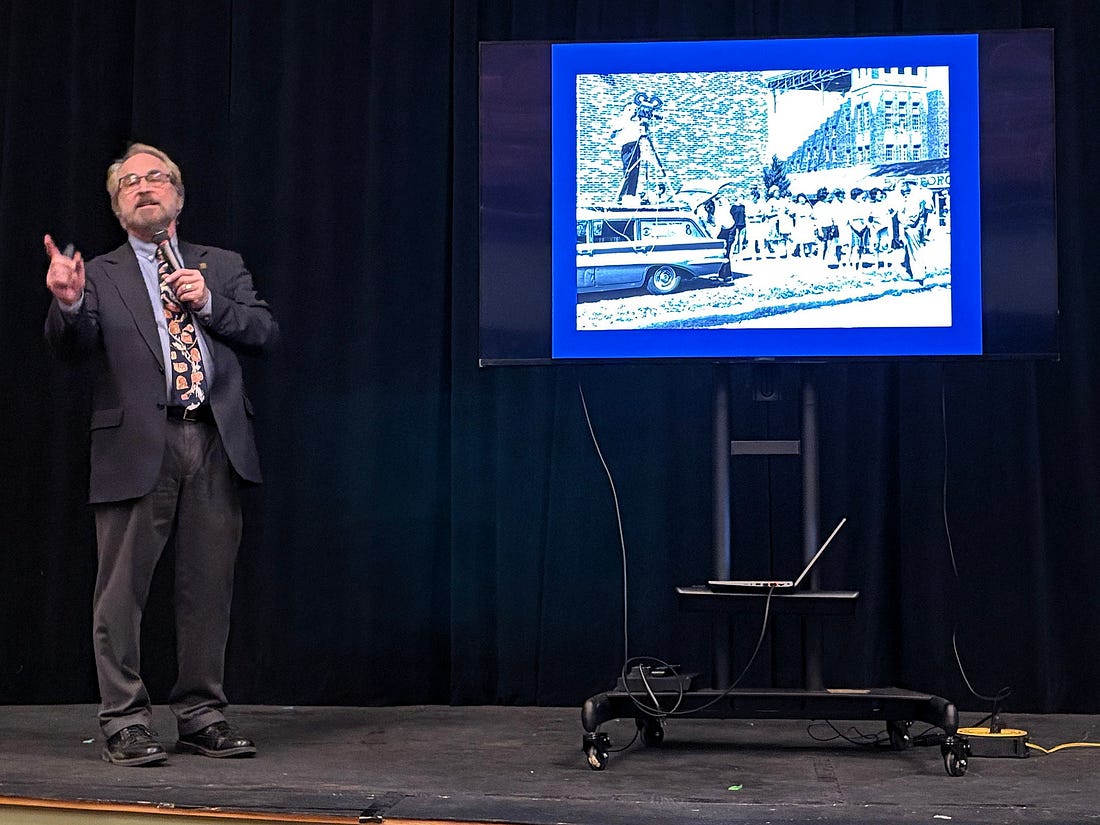
PHOTO BY JEFF MORRISON - Iowa historian and KXEL-AM host Jeff Stein shows a picture of an early television broadcast at the Iowa State Fair during his presentation “Making Waves” on Wednesday, April 8, 2026, at the Wieting Theatre in Toledo, Iowa.
TOLEDO — In order to get mass media to the masses, local reporters and station operators spent the middle of the 20th century experimenting and innovating.
Jeff Stein of KXEL-AM brought his presentation “Making Waves: The People and Places of Iowa Broadcasting” to a small audience April 8 at the Wieting Theatre in Toledo. He was sponsored by the Tama County Historical Society and, like his presentation at Terrace Hill, Humanities Iowa.
This was a homecoming of sorts for Stein. “I was born and raised here, grew up here, and anything good that I’ve ever accomplished, I owe to the fact that I was born and raised in Toledo, Iowa. And anything that I may have done that hasn’t been so good, that’s due to the fact that I spent too much time in Marshalltown,” he joked.
Tama County is a special place for a presentation like this because it’s in position to receive over-the-air signals from both the central and eastern Iowa television markets.
But before television, there was a little bit of Morse code, and then there was radio.
“Norman Baker starred in a radio station called KTNT [in Muscatine]. He said that it stood for ‘Know the Naked Truth.’ … He also ran a medical clinic where he said he could cure cancer. And people would come from around the country for Norman Baker’s cures. Now unfortunately, it was all bogus,” Stein said. Baker ran for governor of Iowa in 1932, which was difficult to do given that he had fled the state.
“I mean, here’s a guy who thought, you know what? I’ve got some sort of notoriety in broadcasting. I’m going to parlay that into a political career,” Stein said of Baker. “Who in the world would think such a thing?” he continued, showing a picture of one-time WHO sportscaster and future president Ronald Reagan.
Stein then brought up another early station, WHAA, soon renamed WSUI for the State University of Iowa. “And when they did that dedication ceremony 102 years ago, a philosophy professor spoke,” Stein said. “You knew you were in for it then, but he made a tremendous point by saying” — and here Stein paraphrased — “‘It’s great that we can broadcast our thoughts around the world, but first, shouldn’t we think great things before sharing those thoughts?'”
Iowa reporters went overseas for World War II. WHO farm reporter Herb Plambeck couldn’t enlist in the military, but could become a war correspondent. He was in Europe when Germany surrendered and had a speech planned out. It was transmitted from London to New York to Des Moines, where “they literally cut a record” to be played on WHO, and the audio file generations later has remarkable quality.
Jack Shelley did reports from both the European and Pacific theaters of the war. He would approach groups of servicemen and ask if anyone was from Iowa. Then he would send telegrams to mayors advising certain towns to tune in to WHO that night to hear a hometown boy be interviewed. One former Iowan he interviewed was Paul Tibbets, pilot of the B-29 plane that dropped the atomic bomb on Hiroshima, Japan. “After the bomb had exploded, and by the time we could turn around and get a look at it, the city was a mass of dust,” Tibbets told Shelley two days after the event.
Shelley later spent more than 25 years as a journalism professor at Iowa State University. By the time he got there, ISU was operating the first television station in central Iowa, WOI. Stein showed a picture of a WOI-TV van outside the Memorial Union with a cameraman on top and two commentators also high up. This was how, in the early years, WOI would broadcast the Veishea parade.
That wasn’t the only setup that today would probably violate labor and safety rules. KRNT-TV did reports from the Iowa State Fair with a cameraman on top of a station wagon. A photo from the WHO-TV studio shows one cameraman positioned behind a pianist to show his hands, another to the side to show a profile view of the pianist and piano, and a third standing on the second camera to provide a high-angle view of the keys.
Local stations put together their own children’s shows. Bill Riley did some on KRNT while also doing ads for Wonder Bread, until new rules put a wall between children’s TV hosts and ads. “Dr. Max and Mombo” of WMT-TV were hired by the Cedar Rapids Chamber of Commerce to do shows downtown during the Christmas season so parents could drop off their kids and go shopping.
Iowa’s most enduring children’s TV icons were in central Iowa. Duane Ellett and Floppy, a puppeteer and his dog, were on WHO for 30 years. After kids summoned the brown beagle with “Where’s Floppy?”, he’d pop out of his box and then banter with Ellett or let kids tell him jokes. “The House with the Magic Window,” the nation’s longest-running locally produced children’s television program, was hosted by Betty Lou Varnum on WOI for 40 of its 43 years. The variety cartoon, craft, and puppet show ended in 1994, when ISU sold the station. Varnum died in August 2021.
A century after radio stations WSUI and WMT got their start, the media landscape has consolidated on the business end and fractured into a million pieces on the audience end. Local TV stations conform to the graphics packages set by their nationwide owners. KWWL almost lost its meteorologists, KGAN has lost its anchors, and WHO and WOI are a court case away from having the same owner.
Today, if someone thinks up a great thing, it might not be shared on the airwaves. It might appear on a podcast instead.
Jeff Morrison is the writer behind the website “Iowa Highway Ends.” He grew up in Traer and now lives in Cedar Rapids. A version of this column was originally published in the Between Two Rivers newsletter on Substack, betweentworivers.substack.com. It is republished here through the Iowa Writers’ Collaborative. Please consider subscribing to the collaborative at iowawriters.substack.com and the authors’ blogs to support their work.
Local News
Chelsea park project comes to fruition with strong community support

Breaking ground on future memories
Tama council finalizes joint police department agreement
This week’s Tama City Council meeting started with an update on a nuisance property, and they decided to extend ...

Elberon man gets six-year federal sentence for illegal gun possession

MSS 2026 Homecoming Court announced
