

Mass saved, for some
Traer to retain weekend Mass; Chelsea, La Porte City among those to lose under Archdiocese of Dubuque’s final pastorate plan
- St. Joseph Parish in Chelsea pictured Wednesday, April 15, 2026. Under the Archdiocese of Dubuque’s final pastorate plan, St. Joseph will no longer hold weekend Mass beginning this July. PHOTO BY RUBY F. MCALLISTER
- A ‘Save Our Churches, Save Our Communities’ yard sign pictured last Friday near the corner of Hwy 63 and Ninth Street in Traer. PHOTO BY RUBY F. MCALLISTER
- St. Paul Catholic Church in Traer pictured Friday, April 10, 2026, ahead of the Archdiocese of Dubuque’s Saturday final pastorate plan announcement. Under the new 24-pastorate structure, Traer will retain weekend Mass as a member of the Marshalltown Area Pastorate; Traer’s current fellow cluster parishes in La Porte City and Eagle Center, as well as nearby St. Joseph Parish in Chelsea, will no longer hold weekend Mass. PHOTO BY RUBY F. MCALLISTER
- Archbishop Thomas Zinkula pictured during the Feast of Corpus Christi Sunday, June 22, 2025, at St. Wenceslaus Oratory in rural Clutier. PHOTO BY RUBY F. MCALLISTER
- PHOTO BY RUBY F. MCALLISTER
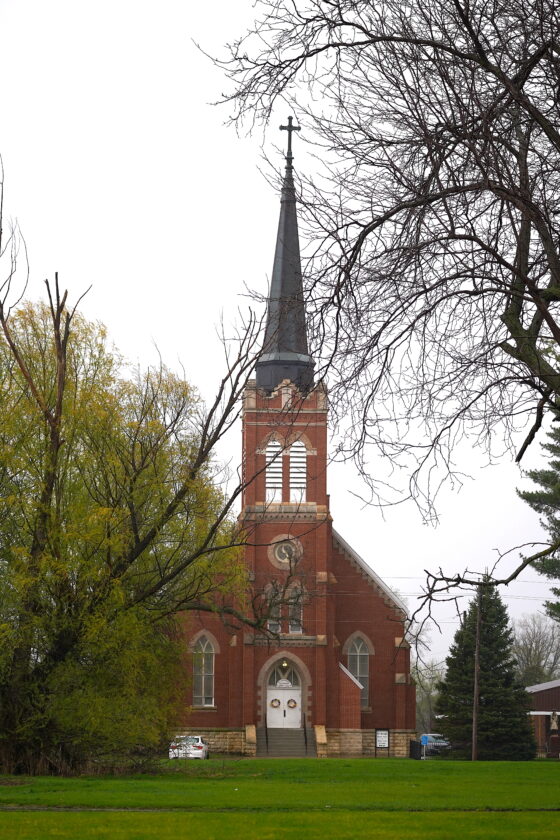
St. Joseph Parish in Chelsea pictured Wednesday, April 15, 2026. Under the Archdiocese of Dubuque’s final pastorate plan, St. Joseph will no longer hold weekend Mass beginning this July. PHOTO BY RUBY F. MCALLISTER
AREA – The physical journey to church will soon be changing for many area Catholics.
In the face of “sobering realities,” Archbishop Thomas Zinkula announced last Saturday the Archdiocese of Dubuque’s final pastorate plan to reshuffle 160 Catholic parishes across northeast Iowa after nearly a year of data gathering. The plan, dubbed Journey in Faith (JIF), somewhat unexpectedly preserved weekend Mass for Traer’s St. Paul parish, while eliminating the same for the area parishes of La Porte City, Eagle Center, and Chelsea.
“I have reached decisions regarding the pastorate structure for the Archdiocese of Dubuque and the priest assignments that will support its implementation. Moving forward, the Archdiocese of Dubuque will be organized into 24 pastorates,” Archbishop Zinkula explained in a roughly seven-and-a-half minute video posted to the JIF website early Saturday, April 11. “A pastorate is a group of parishes that will work together more closely, sharing pastoral leadership, ministries, and resources in order to strengthen the mission of the Church in their communities. Each pastorate has been assigned a pastor and a parochial vicar or vicars. The weekend Mass locations for each pastorate have been determined as well.”
As it stands now, Traer’s St. Paul Parish is part of the Prince of Peace Cluster which also includes Sacred Heart Parish in La Porte City and St. Mary of Mt. Carmel Parish in Eagle Center (rural Waterloo). All three parishes share a priest on a four-month Mass rotation consisting of Saturday at 5 p.m. and Sunday at 8 a.m. and 10 a.m. But come this summer, all that will change in the wake of Archbishop Zinkula’s announcement.
Beginning mid-July, Traer’s parish will retain weekend Mass, but La Porte City and Eagle Center will not. At that time, Traer will become part of the Marshalltown Area Pastorate; La Porte City and Eagle Center will join the Independence Area Pastorate.
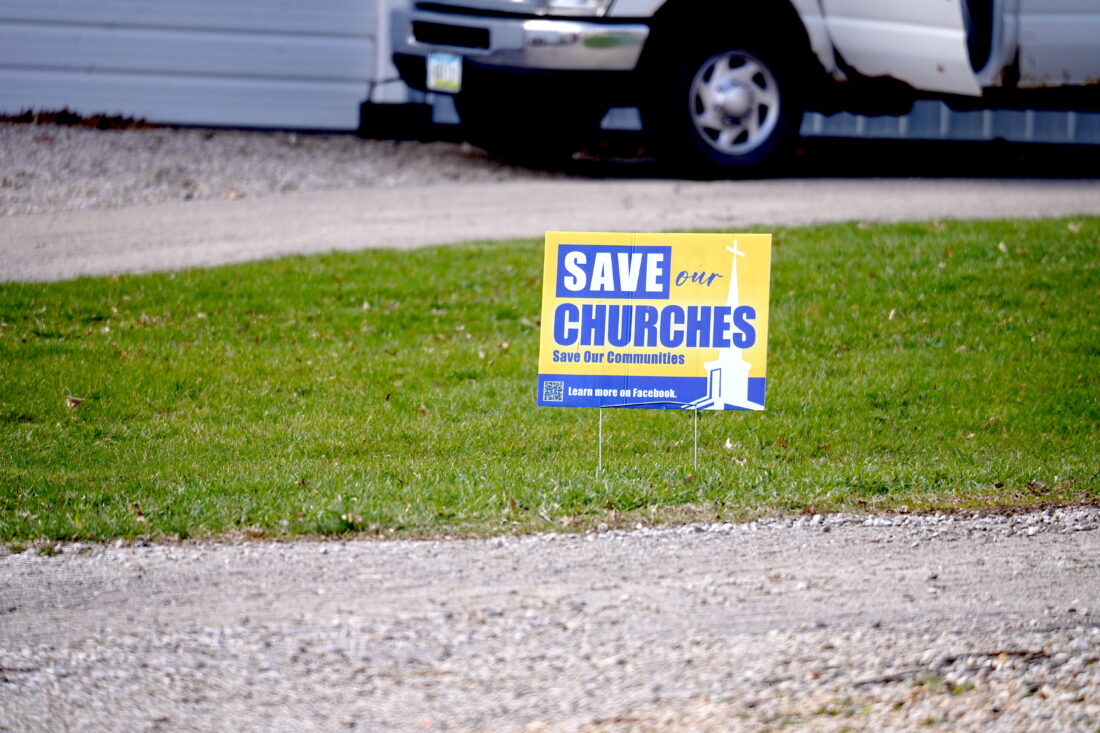
A ‘Save Our Churches, Save Our Communities’ yard sign pictured last Friday near the corner of Hwy 63 and Ninth Street in Traer. PHOTO BY RUBY F. MCALLISTER
“The number of faithful attending Mass has declined by 46% in 20 years and the number of priests available for ministry has been decreasing. The need for Evangelization, Leadership Formation, and Pastoral Planning is evident,” Archbishop Zinkula further said on Saturday. “[But] demographic realities, the decline in the number of priests and religious, and the need for priests to serve more than one parish aren’t signs of failure. They are signs of change. And change in the life of the Church has always called the faithful to deeper trust.”
Tama County’s Catholic Churches
Ahead of Saturday’s announcement, it seemed almost a given Traer would lose weekend Mass based on regional pastorate models proposed last year. When contacted by the newspaper Saturday, more than a dozen area Catholics expressed shock at the news, particularly in light of nearby St. Mary Parish in Vinton losing Mass under the final plan.
But for parishioner John Svoboda of Clutier – a member of St. Paul’s JIF core team – eliminating Traer’s weekend Mass did not make sense geographically.
“With the first round of mapping. I was looking at the area – and there was such a big void between Marshalltown and Tama and Waterloo. That was a big area there and we were right in the middle. I thought, nah, they won’t take it away from us,” John said during a Sunday morning sit-down with the newspaper that also included his wife Marilyn Svoboda.
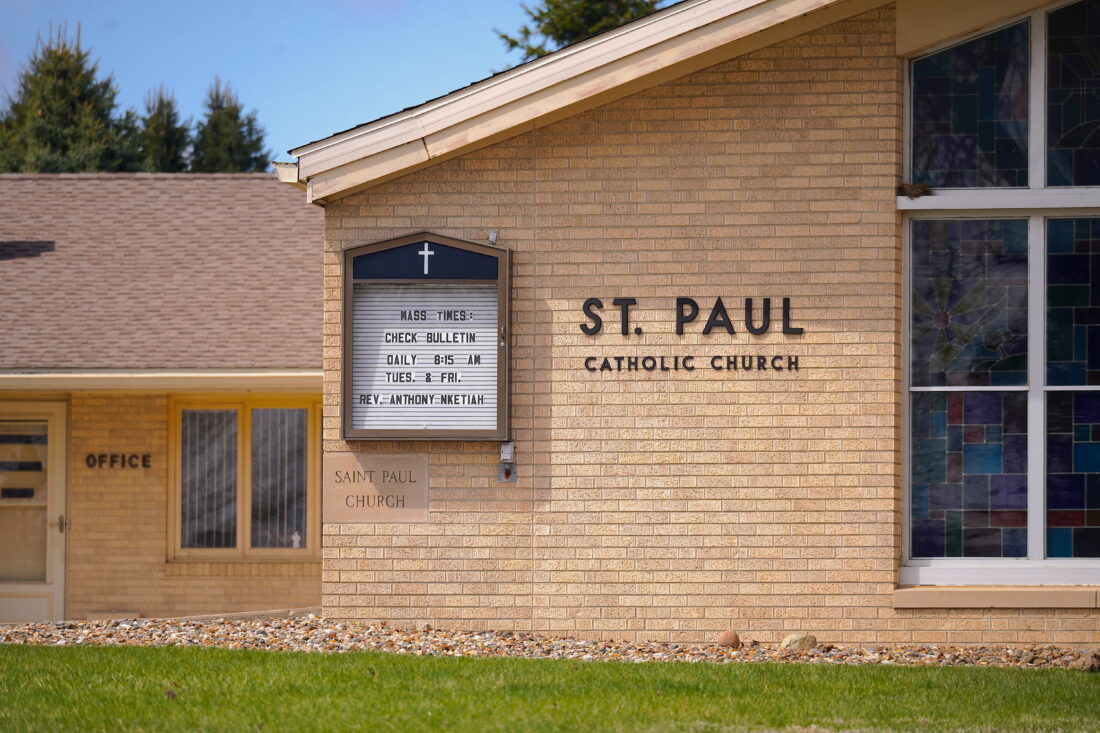
St. Paul Catholic Church in Traer pictured Friday, April 10, 2026, ahead of the Archdiocese of Dubuque’s Saturday final pastorate plan announcement. Under the new 24-pastorate structure, Traer will retain weekend Mass as a member of the Marshalltown Area Pastorate; Traer’s current fellow cluster parishes in La Porte City and Eagle Center, as well as nearby St. Joseph Parish in Chelsea, will no longer hold weekend Mass. PHOTO BY RUBY F. MCALLISTER
“We were on the chopping block, on the first map,” he continued, “[but] it was such a big area, there was no other Catholic Church in the area. And so that’s why I thought – we’d stay open. … We have a lot of older people in town (who) can (only) drive in town or maybe a mile or two out of town. So they can’t really go anywhere. That was another big factor. The area that we covered – the big void there – and the elderly.”
The effect of local advocacy efforts on the final pastorate plan also can not be ruled out, Marilyn said, before citing multiple instances of St. Paul parishioners who sent letters and emails or made phone calls to the diocese, advocating for Traer to keep weekend Mass.
As seismic as Saturday’s announcement was for a great many Catholics in Iowa, the Svobodas have, in a way, been here before.
John, 78, was born and raised in rural Clutier and baptized at St. Wenceslaus Church, colloquially known as the Bohemian church, located west of town. His father, the late Charles Svoboda was the first baby baptized in the church on Christmas Day 1900. In 1992, St. Wenceslaus became St. Wenceslaus Oratory following its sudden closure by the diocese. John and Marilyn and their children then attended Immaculate Conception located in Clutier proper before it, too, was closed – first becoming an oratory in 2006 before being sold in 2012.
According to Traer Historical Museum President George Kadrmas, an oratory is “a place of prayer other than the parish church, set aside by ecclesiastical authority for celebration of the Mass and devotional services.”
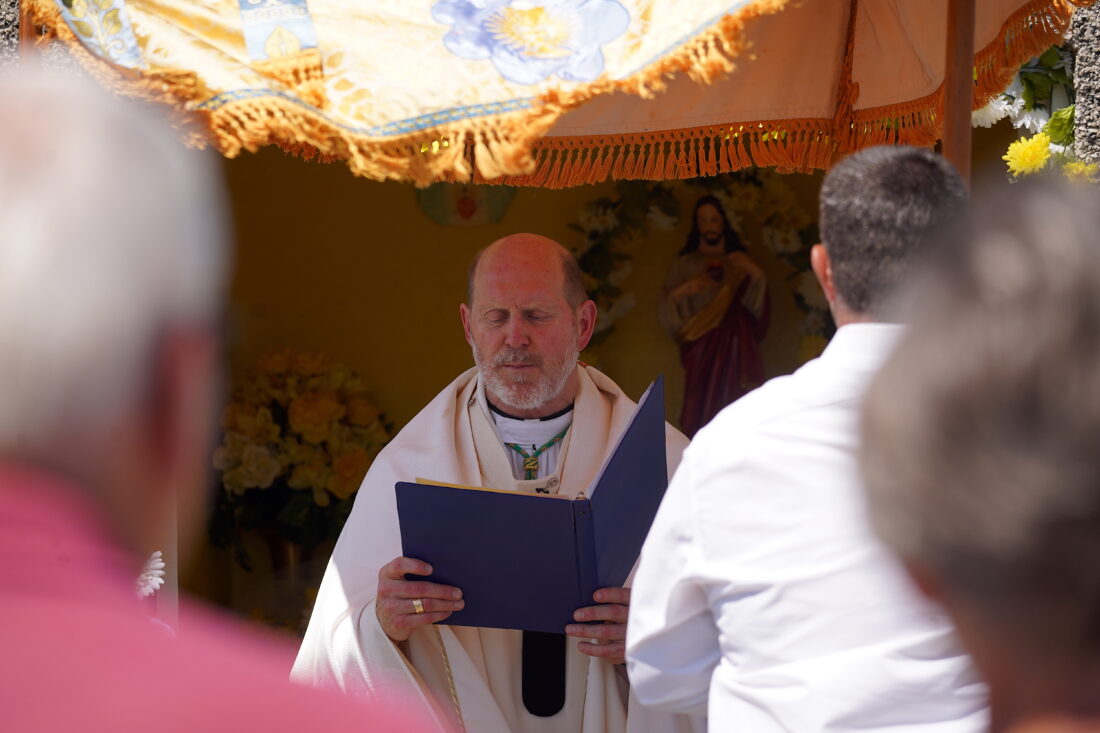
Archbishop Thomas Zinkula pictured during the Feast of Corpus Christi Sunday, June 22, 2025, at St. Wenceslaus Oratory in rural Clutier. PHOTO BY RUBY F. MCALLISTER
“It was all kind of a mass closing,” John explained of the late ’90s-early ’00s closures. “They closed Clutier, Garwin, Vining, Dysart, and Blessing (rural Hudson) up there in the north.”
But this time around, no churches are closing, per the Archdiocese of Dubuque, which stressed in an email sent to media outlets ahead of Saturday’s announcement: “Parishes are not closing. Church buildings are not closing. Church names remain the same. Pastorates are not mergers.”
In his Saturday morning message, Archbishop Zinkula further explained, “Churches not used as weekend Mass sites can be used for weekday worship, faith formation, adoration, service to the community, weddings, funerals, and more. Whenever possible, the goal is to ensure these spaces continue to serve the mission of the Church in meaningful ways.”
“As long as you have the money (to maintain the buildings), those without weekend Mass, they’re not closed,” John said at one point during his interview before explaining how St. Wenceslaus Oratory is maintained today through a mix of local fundraising – including the annual Feast of Corpus Christi lunch hosted by St. Paul’s Parish – and interest generated off an initial investment made following the closure.
Last December, the newspaper reached out to Deacon John Robbins, Director of Communications for the Archdiocese of Dubuque, regarding St. Wenceslaus Oratory and how it might be affected by the final pastorate plan. His response, a Statement from the Archdiocese of Dubuque, gives some insight into how parishes that are losing weekend Mass might one day function.
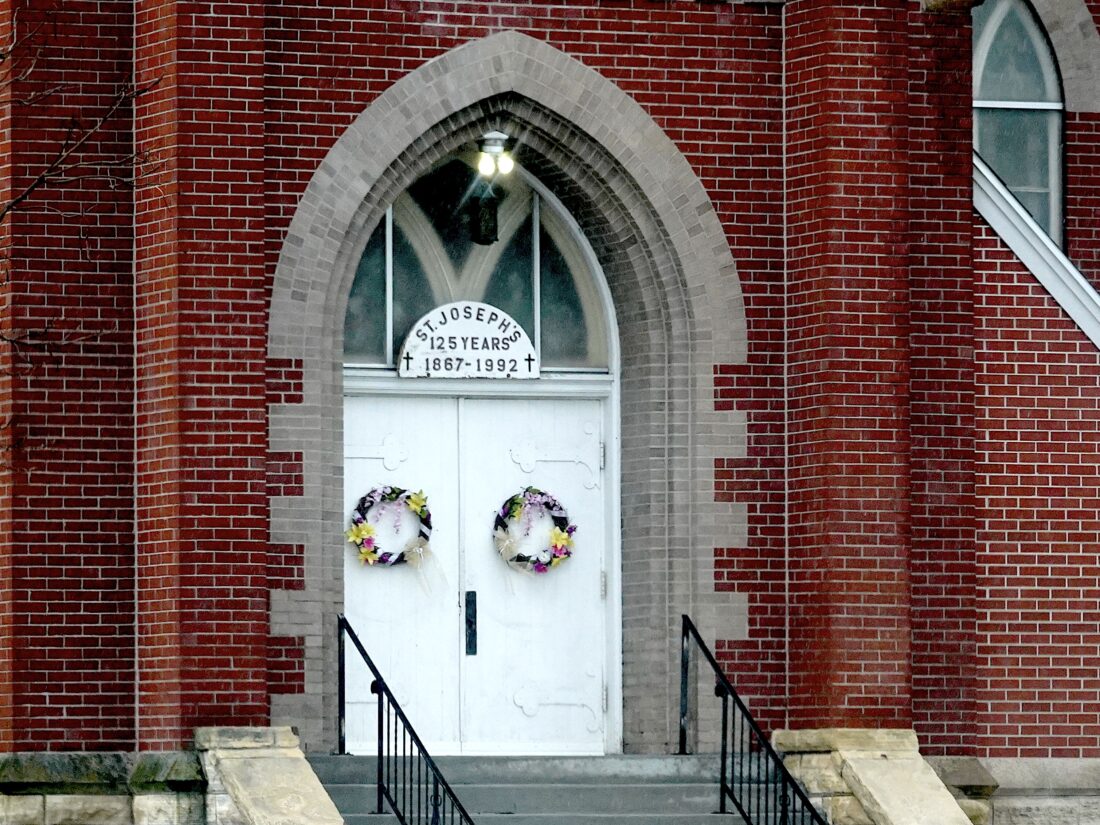
PHOTO BY RUBY F. MCALLISTER
“Other churches (formally called oratories or non-parochial churches) will be part of a new pastorate,” Robbins wrote in a December 2025 email. “When pastorates become active in July 2026, no other changes will happen with other churches/oratories/non-parochial churches. They will continue to function as they have in the past. However, like all church buildings, local leadership at the newly formed pastorates will need to continually assess their worship and ministry space needs along with their financial ability to support and maintain multiple churches.”
Despite such statements, it’s still hard for many Catholics – especially those whose parish is losing Mass – not to see the removal of weekend Mass as that first step toward a possible, eventual closure, including Dysart Mayor Tim Glenn.
“You know, as mayor of a small town in rural Iowa it’s disappointing to see the Archdiocese of Dubuque make these changes,” Glenn said in an email to the newspaper this past Monday. “I know it is imperative for changes to be made due to lower attendance and the lack of priests to cover all parishes. [But] as a member of the Prince of Peace Cluster (Traer, Eagle Center, La Porte City) it is very sad to see St. Mary’s (of) Mt. Carmel and Sacred Heart lose their weekend Masses. These are the parishes and communities of rural Iowa that helped build the Archdiocese of Dubuque through generations of families.”
He continued, “I guess the only ‘Journey in Faith’ that the members of these parishes will make is a much longer drive to experience Mass and receive their sacraments that are so important in their life. I’m pretty sure knowing the parishioners of these churches, they won’t let a few more miles keep them from practicing their Catholic faith.”
Marshalltown Area Pastorate
The new Marshalltown Area Pastorate includes St. Francis of Assisi Parish in Marshalltown along with St. Patrick Parish in Tama, St. Paul Parish in Traer, St. Joseph Parish in Chelsea, and St. Michael Parish in Belle Plaine.
Under the final pastorate plan, weekend Masses in the Marshalltown Area will be held at St. Henry (three English, two Spanish); St. Michael (one English); St. Patrick (one English, one Spanish), and St. Paul (one English).
The new pastorate will be served by four priests, including Fr. Alan Dietzenbach as pastor, and Frs. Andrew Awotwe-Mensah, Greg Bahl, and Michael McAndrew as parochial vicars. Two of the priests are familiar faces – Dietzenbach is currently assigned to Marshalltown and McAndrew (on sabbatical) is currently assigned to the Circle of Saints Cluster of Tama, Chelsea, and Belle Plaine.
Awotwe-Mensah, a Priest of the Archdiocese of the Cape Coast in Ghana, Africa, is currently assigned to St. John the Baptist Parish in Mount Vernon, while Rev. Bahl is currently the Director of the Archdiocesan Office of Worship at Mount Mercy in Cedar Rapids.
‘Change can be difficult’
Toward the end of his address Saturday, Archbishop Zinkula briefly touched on the “controversy” surrounding weekend Mass changes, stating, “There are voices and concerns that risk dividing us, particularly around Sunday Mass in some communities. Even so, I am confident that, as we remain united in the Holy Spirit and grounded in the Eucharist — wherever we gather for worship — the Lord will bring this process to a good and grace-filled outcome.”
He also said, “I know change can be difficult. At the same time, our mission calls us to look beyond what is comfortable and familiar and ask how we can best proclaim the Gospel in the years ahead.”
As part of the reporting for this story, the newspaper reached out to Prince of Peace Cluster Coordinator of Religious Education (CRE) Sarah Kopriva of rural Clutier, a young mother and member of St. Paul Parish, regarding Saturday’s announcement. Kopriva expressed both joy and heartache following the news.
“There’s certainly joy and relief knowing our prayers were heard here at St. Paul,” she wrote in a statement. “Our hearts still are sad with those feeling the loss of weekend Masses at their parish – change is never easy. I am praying that this is a temporary loss, and that we can truly experience a revival of faith in our diocese through this process.
“As a mother and as the (CRE) for our cluster the past three years, I am happy to see that the diocese is encouraging us to keep all of our churches active in forming the faith of our young people by stating that all churches can still be used for religious education, weekday Masses, special events, funerals, weddings, and service to our communities.
“While the weekend Mass is a huge part of a Catholic Church’s purpose, it makes me feel hopeful that across the diocese, our churches can still serve their communities in different ways so that even in this time of difficulty, we can shine the light of Christ in the world around us.”
For John Svoboda, the new pastorate plan – meant to guide the Church for at least the next quarter century, he said – presents an exciting opportunity.
“I’m kind of excited about all these changes. The whole goal of this was to get the community more excited, more vibrant. … This, I think, will revitalize us. Bring more people back.”
Later in the interview, John was asked if he was concerned at all about losing Catholics due to all the changes — especially those facing longer journeys to unfamiliar parishes.
“There will be some people that will quit going,” he conceded. “You’re always going to lose one or two. … But after a while, they’ll get to it – they’ll (come back). It just depends on your faith, you know?”
For more information regarding the Journey in Faith Final Pastorate Plan set to take effect July 14, 2026, visit dbqjourneyinfaith.org/final-pastorate-plan.
Local News
Chelsea park project comes to fruition with strong community support
Breaking ground on future memories
Tama council finalizes joint police department agreement
This week’s Tama City Council meeting started with an update on a nuisance property, and they decided to extend ...

Elberon man gets six-year federal sentence for illegal gun possession

MSS 2026 Homecoming Court announced
