

Story of “The Devil’s Anvil” – A look back in Tama County history
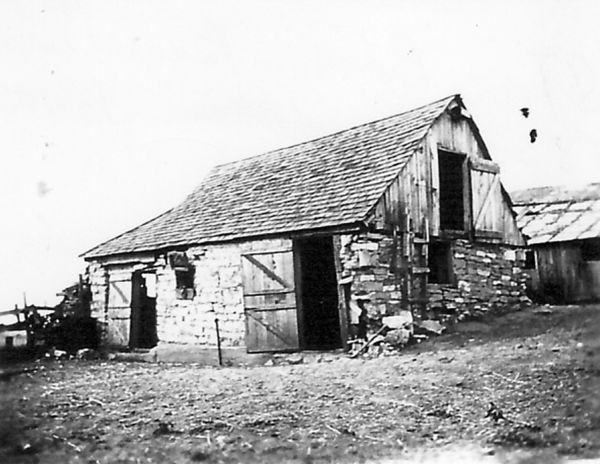
Stone barn built in 1853 by Jonas Dunham Sr.
Every time my family went to Marshalltown when I was a child we passed the “Old Stone Barn” (as we called it) on Highway 30, which led into the story of the “Devil’s Anvil.” My Great Grandfather, Jonas Dunham Sr. settled here in 1852 and bought 160 acres of land from the government in Section 7 of Indian Village Township. This land included what was known as “The Devil’s Anvil”.
Ninety three years ago two people from the little town of LeGrand enjoyed the rare opportunity of interviewing Horace Poweshiek, a young man of the Mesquakie tribe and a great-grandson of the famous Chief Poweshiek, alert to pick up any new threads of the legendary story of the blacksmith who once dwelt in the “Devil’s Anvil”.
Poweshiek had come to spend the day with his brother, Jonas Poweshiek, who was visiting with a Curator from the Iowa State Historical Museum.
LeGrand resident Albert Beane and the editor of the LeGrand Reporter, conversed with Jonas Poweshiek while watching drillers at work in the quarries, and had the opportunity to refer to the “Devil’s Anvil” legend, the first version which was told by Young Bear several years ago. Mr. Poweshiek assured the two men that he knew of the legend and was able to shed some light on a phase of it which Young Bear had failed to clear up.
Poweshiek mentioned that none of the early white settlers had ever been able to locate the spot on the hill where they could distinguish the pulsing or pounding . Horace explained that “Wee-twee-ah”, Indian name for the blacksmith spirit, had deserted his abode in the stone hill since the coming of the white settlers, and this was the reason his pounding was no longer heard.
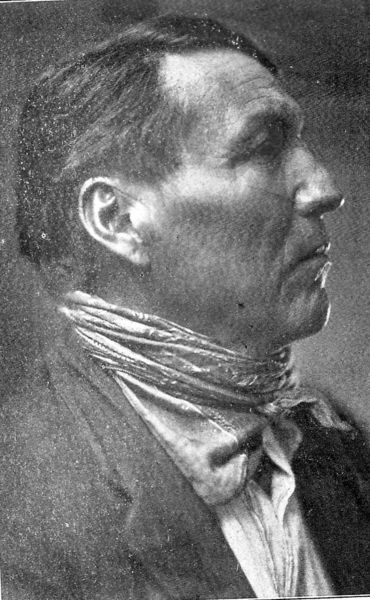
Ma-Qui-Ba-Na-Sha Young Bear
Poweshiek stated “Wee-twee-ah” was easily ruffled and if he lost his temper when people were about the spring he would send out a flood of water and drown the objects of his wrath. Poweshiek told the two men there were two spirits of opposite character or attributes, “Ke-che Man-i-tou, the good spirit and Much-ee Man-i-tou, the bad spirit.
In explaining why the blacksmith was said to have left his former haunt, Poweshiek stated the white people were too much given to “”tearing things all to pieces.” With a gesture of his hand Poweshiek pointed toward the jagged face of the stone cliff. If they find a beautiful pond or pool of water, the first thing they think of is to dig a ditch and drain the water off.
Poweshiek went on to say “There are other spirits in other places which have done the same thing.” He went on to explain that near Tama on Deer Creek was the spirit of a woman with long hair. On nice days she might often be seen sunning herself. She’s gone too.”
Another tale told of the “Devil’s Anvil” some of the older generation may remember was the one by Jonas Dunham of Montour. Dunham stated his father, Jonas Dunham Sr., lived on the Anvil in the early days and he claimed the fine spring at the north west corner of the big hill was the real source of the puzzling name, and that the Indian word for “spring” sounded like the English word “anvil”. So far so good, but no one had taken the opportunity to ask one of the Mesquakie for their word for “spring”. When Youngbear, son of the Mesquakie chief Pushetonenequa, had the opportunity to make known what was wanted. His word for “spring” sounded nothing like “anvil”, nor did any other word he could mention.
The intelligent light in Young Bear’s eye and a knowing glance to another Indian near by who had caught the drift of the conversation, showed plainly they knew well enough what was wanted and Young Bear explained: “Old people tell me the blacksmith back in the hill would leave a broken brass kettle in spring, go away, come back next day and the kettle would be mended. His word for blacksmith sounded nothing like “spring”. Asked if by placing an ear to the ground anywhere on the hill one could hear a rumbling or pounding sound, as some have claimed. He shook his head and said there was nothing in it to his knowledge.
Many more stories of “Devil’s Anvil” have been told through the years. One last tale I heard when I was a child came from my uncle who lived in Indiantown with his grandfather, Washington Asher. He stated he could remember Indians going to the Anvil and placing their ear on the ground. He claimed they could feel or hear a vibtration which would tell them if anyone were headed toward their settlement.
Another factual story on the Anvil was in the 1930’s during depression years Tama County had a group of men (WPA) working in the quarry. They did not have equipment as they have today. Those men used “Pick axes”, wheel barrows , etc. in their work to produce gravel for Tama County roads.
Many will remember plenty of vibration at this location when organized Moto-Cross racing and Motorcycle hill climbing took place . Plenty of vibration was noted at this time.
- Stone barn built in 1853 by Jonas Dunham Sr.
- Ma-Qui-Ba-Na-Sha Young Bear
Local News
Helping Tama County thrive

2026 MSS Homecoming Royalty crowned
St. John Lutheran Church to celebrate 150 years Sunday
St. John Lutheran Church will celebrate 150 years on Sunday, October 18, 2026. The church itself had its ...
Chock full of public hearings
This week’s Toledo City Council meeting was chock-full of public hearings. It started with a hearing on the sale ...

For the love of Frankenstein
