Environmental risk factors for cancer presented during meeting in Toledo
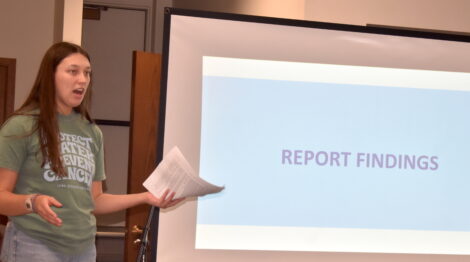
- NEWS CHRONICLE PHOTOS BY ROBERT MAHARRY – Kaitlyn Sorensen of the Iowa Environmental Council presents during a meeting on the environmental risk factors of cancer in the state at the community room inside the downtown State Bank of Toledo on Thursday, Oct. 15.
- Tama County Supervisor David Turner, right, and a representative from the Iowa Farmers Union converse during a meeting about environmental risk factors for cancer at the downtown State Bank of Toledo last Thursday afternoon.
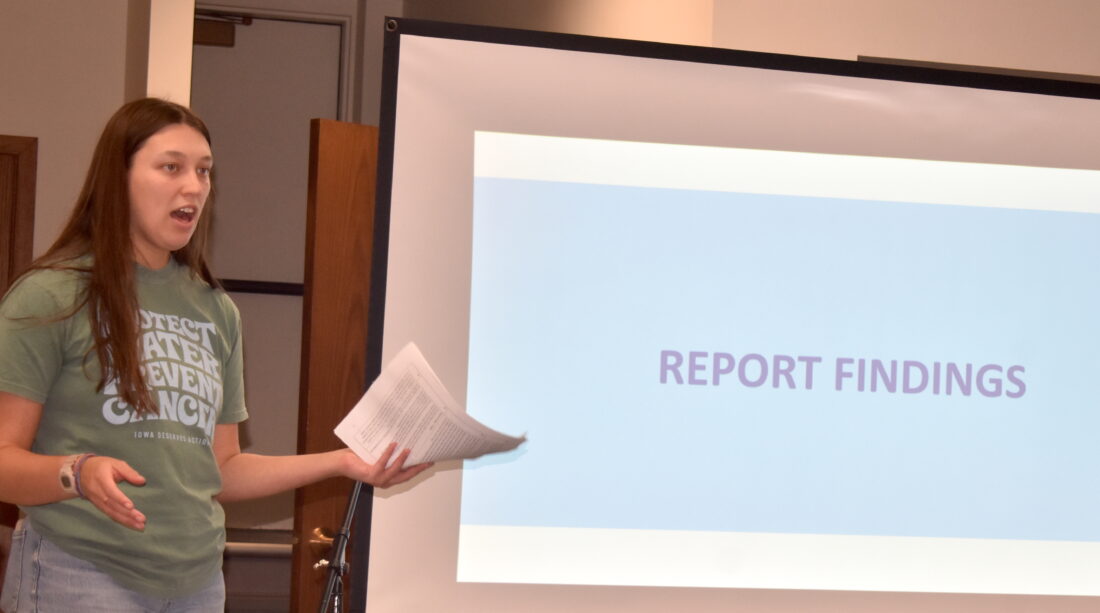
NEWS CHRONICLE PHOTOS BY ROBERT MAHARRY – Kaitlyn Sorensen of the Iowa Environmental Council presents during a meeting on the environmental risk factors of cancer in the state at the community room inside the downtown State Bank of Toledo on Thursday, Oct. 15.
Just over a year after several of the same leaders held a listening session at the Meskwaki Tribal Center in August of 2025, representatives from the Iowa Environmental Council and the Harkin Institute invited community members to the meeting room at the downtown State Bank of Toledo location last Thursday for a session focused on the environmental risk factors behind Iowa’s cancer crisis.
About 10 to 15 people attended the most recent event, including members of the Meskwaki Nation’s Natural Resources team, Tama County Supervisor David Turner and Iowa House District 53 candidate Berleen Wobeter. Drawing from a recently released comprehensive report on cancer in Iowa, Kaitlyn Sorensen of the Iowa Environmental Council provided some background and noted that rural counties like Tama are generally seeing higher cancer rates than the rest of the state. Currently, almost all forms of cancer continue to rise in Iowa.
Tama County is ranked in the top 10 in the state for new instances of cancer per 100,000 people among all 99 counties, while rates for people under 50 are closer to the state and national medians. One upside she shared is that cancer is treated well in Iowa, and the mortality rate in Tama County is within the state and national averages.
Kerri Johannseen, also of the IEC, went more in-depth on the specific risk factors for cancer, namely exposure to pesticides, insecticides, fungicides and herbicides through the skin, ingestion in water or on food and inhalation. Iowa has consistently ranked as the top state for glyphosate use, which is the active ingredient in Roundup herbicide.
Another common risk factor are the “forever chemicals” or PFAS that take an extremely long time to break down, which are common in household products, firefighting foam and pesticides. PFAS has been detected in Iowa’s groundwater and surface water, and the highest concentrations were found in shallow groundwater wells near large rivers and downstream of wastewater treatment plants.
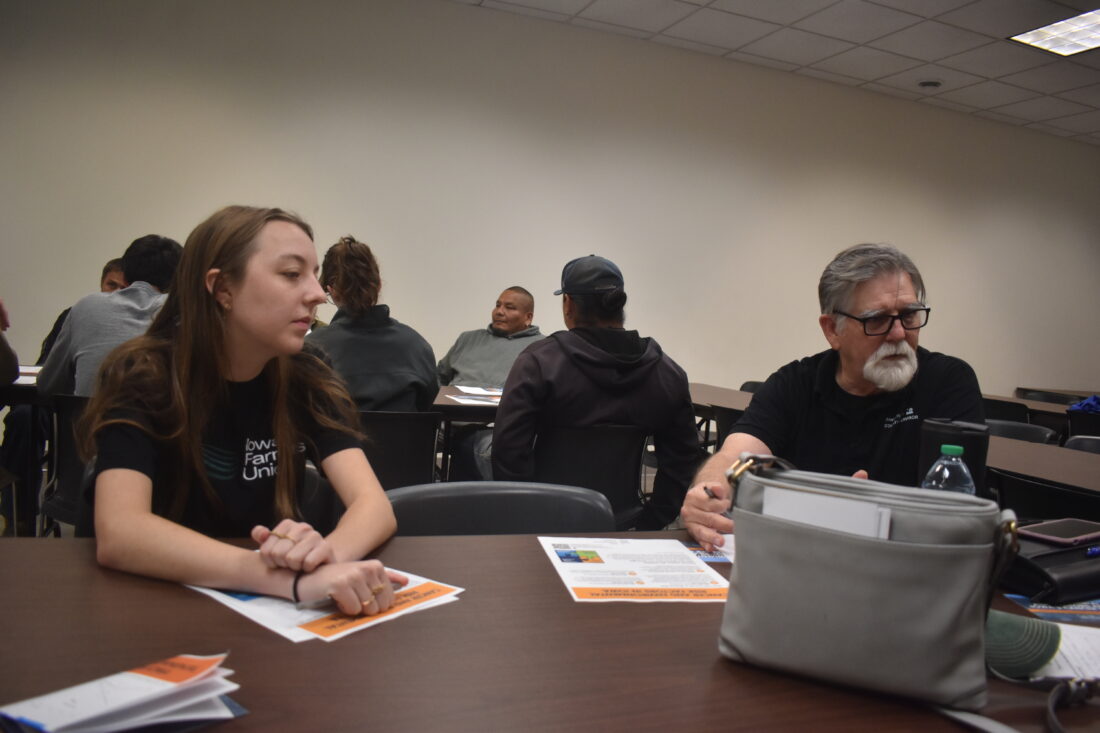
Tama County Supervisor David Turner, right, and a representative from the Iowa Farmers Union converse during a meeting about environmental risk factors for cancer at the downtown State Bank of Toledo last Thursday afternoon.
Nitrates are another common topic of discussion in the water quality conversation, and despite federal regulations limiting the allowable amount in drinking water to prevent Blue Baby Syndrome, Iowa’s water systems are struggling to meet the requirement. Agriculture is the primary driver of nitrate production through both row crop and livestock operations, especially animal waste, and the vast majority of nitrates in Iowa come from non-point sources such as farms.
Iowa is home to more Concentrated Animal Feeding Operations (CAFOs) than any other state, and Johannsen also pointed to the prevalence of drainage tile that reroutes water out of fields.
“The excessive amount of nitrate in Iowa’s environment also presents an enormous challenge for public water suppliers,” she said.
The final major risk factor presented last Thursday was Radon, a naturally occurring gas, and Iowa is considered a hotspot. Exposure is the second-leading cause of lung cancer after smoking. The biggest takeaway from the report, Johannsen said, is that Iowa is an outlier on exposure to radon, pesticides and nitrates compared to other states.
The last presenter of the day was Iowa Food System Coalition Executive Director Tommy Hexter of Grinnell, who ran for the HD 53 seat back in 2024 as a Democrat, and he spoke about public expenditures related to water quality and mitigation measures as well as the overall farm economy outlook in light of soaring input costs and declining profit margins.
“In my opinion, we need to be thinking about what is our investment of $1.5 billion a year, what result is that actually leading to? It’s not leading to farmers thriving. It’s more leading to corporations thriving, and so I think we do need to retool our entire crop system, and it begins by thinking about the supply. Why do we actually need to produce as much of these two crops (corn and soybeans) as we are?” he asked. “We’re producing way more corn and soybeans in Iowa than we need, and that excess of supply is leading to prices being lower for farmers. And so if we were to take some of the acreage out of production in smart ways and transfer it to diversify production, growing more food for our state, putting more ecological services in, soil health, restoration, habitat restoration. I think there’s a lot we need to do, but the key question in my mind is what are we doing that actually benefits farmers and not that benefits the system that continues to lead to overproduction and record profits for the input companies?”
Healthier soils with less inputs, he added, will improve yields and lower expenses for farmers. The session ended with questions generated in small group conversations, and Johannsen emphasized the importance of a collaborative set of solutions acknowledging the problem. Attendee Karen Murty felt that the blame couldn’t be placed on farmers, especially as so many are struggling to hold on financially, and she cited other factors such as consumers’ demand for cheap and processed food, alcohol consumption, non-farmers using weedkillers in their lawns and the COVID-19 vaccine.
“There’s so many things here that are at cause. It is not just that farmer that farms maybe 5 or 10,000 acres,” Murty said.
In conclusion, the presenters urged attendees to advocate for policies that will clean up Iowa’s water and in turn reduce the cancer rate over time.
“We just have a lot of collective energy and resources in this room where I think we need to keep showing up and making these issues heard,” Hexter said.
Local News
Southern comfort
‘Homespun’ to visit on Oct. 25
TOLED0 — First Presbyterian Church of Toledo will host "Homespun," a gospel Country and Blue Grass musical family ...
Environmental risk factors for cancer presented during meeting in Toledo
Meet the Iowa House District 53 Candidates: Berleen Wobeter
Snapping Right Through
The Tama City Council meeting started by snapping through agenda items left and right. They started by hiring a new ...