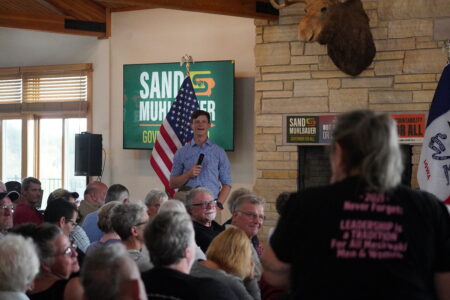
Bushaw makes independent pitch during Tama campaign stop
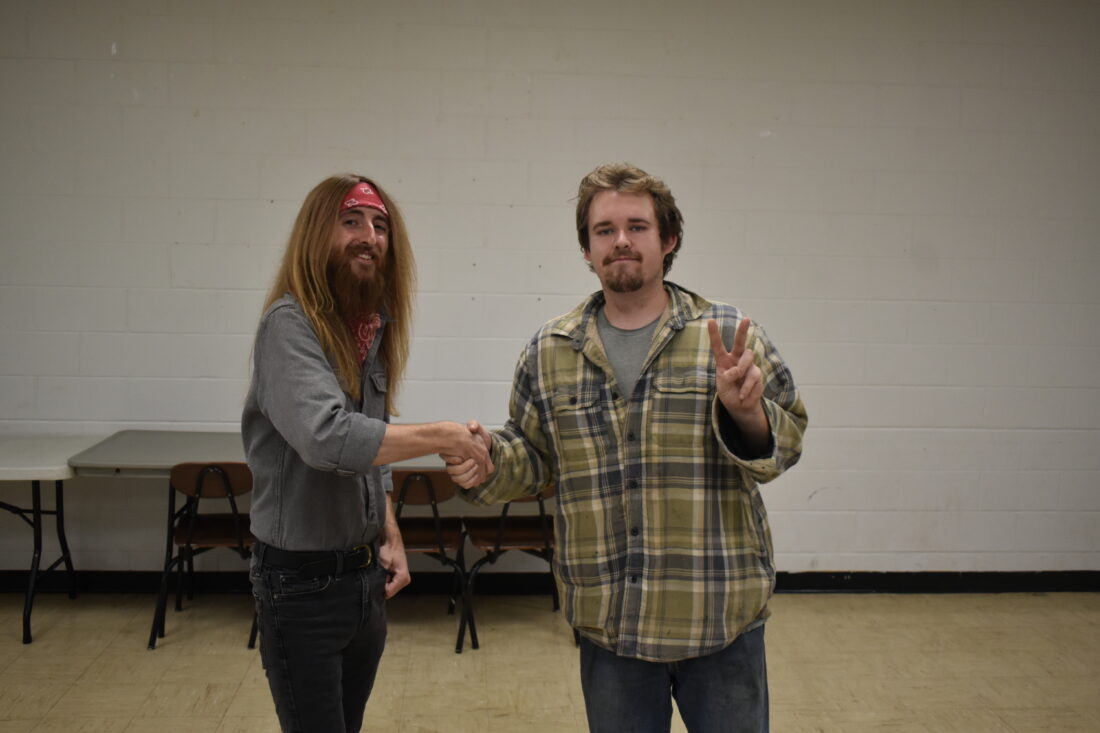
PHOTO BY JONATHAN MEYER - Dave Bushaw, an independent candidate for Iowa’s 2nd Congressional District, poses for a photo with an attendee following a campaign event at the Tama Civic Center last Saturday.
Independent congressional candidate Dave Bushaw spent about an hour and a half making his case for a different kind of politics on Saturday, frequently turning the conversation back to the people sitting around the table.
Bushaw, the no-party candidate for Iowa’s open 2nd Congressional District seat, is one of four candidates who will appear on the Nov. 3 ballot alongside Democrat Lindsay James, Republican Joe Mitchell, and Libertarian Rick Stewart.
Rather than delivering a traditional stump speech, Bushaw spent much of the event asking attendees about the issues driving them to the polls and responding to questions on everything from immigration and the cost of living to homelessness, marijuana laws, foreign policy, and political corruption.
Bushaw described his campaign as an attempt to build an independent political infrastructure outside of the Democratic and Republican parties, drawing heavily on his background in labor and community organizing.
“I want to build solid, foundational infrastructure that we can build and expound onto for the future,” Bushaw said.
The farmer, musician, and longtime organizer previously worked as a rural organizer for Bernie Sanders’ 2020 presidential campaign. He told the group his own campaign grew out of frustration with Congress and a belief that neither major party adequately represents working-class voters.
Several attendees echoed concerns about political corruption and the influence of money in government, while others raised the cost of fuel and basic necessities, immigration, homelessness, and mental health services.
Bushaw outlined a platform that mixes positions typically associated with both sides of the political spectrum. He voiced support for universal health care, stronger organized labor protections, guaranteed child care access, marijuana reform, and campaign finance changes while also defending gun rights and calling for stronger border enforcement.
His three primary priorities, Bushaw said, are improving water quality, establishing national ballot initiatives that would allow voters to decide policy questions directly, and guaranteeing universal health care.
Foreign policy produced the sharpest disagreement of the afternoon.
Bushaw, who described himself as a longtime anti-war organizer, said he opposed using American taxpayer dollars to finance Israeli military operations and argued the United States should focus its resources domestically.
“If they want to spend their own money, that’s up to them,” Bushaw said of Israel. “If they want to spend their own money waging conflicts in the Middle East and making enemies out of everybody, that’s on them.”
Asked directly about the Israeli-Palestinian conflict, Bushaw said he supports Palestinian sovereignty and added, “I want to focus on our borders here before we’re off fighting every other conflict abroad.”
One attendee, who had questioned Bushaw on the issue, thanked him for his time and left the meeting shortly after the exchange.
Bushaw returned to the subject later while discussing his broader platform.
“I’m more focused on fighting the wars here at home, rather than fighting imperial conquest abroad,” he said.
The conversation also turned repeatedly toward Bushaw’s exclusion from some of the televised debates planned for the 2nd District race.
Iowa PBS has scheduled an Oct. 8 debate between James and Mitchell. The network’s published criteria require federal candidates to qualify for the ballot and meet at least four of five additional benchmarks involving party recognition, an established campaign presence, fundraising, news coverage, and polling.
Bushaw has raised substantially less than the two major-party nominees. Federal campaign finance records through June 30 showed approximately $26,000 in receipts for Bushaw’s campaign compared with more than $1.6 million for James and $1.9 million for Mitchell.
Bushaw argued that debate standards based in part on fundraising make it more difficult for independent and minor-party candidates to reach voters.
The debate issue has also created an unusual point of agreement among three of the four candidates. Mitchell has publicly called for Bushaw and Stewart to be included in debates, and Bushaw has said he, Mitchell, and Stewart all support allowing every ballot-qualified candidate onto the stage.
James has committed to televised debates with Mitchell through Iowa PBS and Iowa’s News Now. When Iowa Capital Dispatch reported on the issue in August, James’ campaign did not respond to a request for comment about including Bushaw and Stewart.
During the Tama event, Bushaw was pointed in his criticism of James, saying he has attempted to communicate directly with her campaign and contrasting that relationship to his interactions with Mitchell and Stewart.
“I’ve made every effort,” Bushaw said.
Despite major policy disagreements, Bushaw said he has been willing to sit down with his Republican and Libertarian opponents because he believes candidates should remain accessible to one another and to the people they hope to represent.
At one point Bushaw asked attendees on whether they would prefer to see an organized third party or a “no party” movement develop from campaigns like his.
Bushaw said he intends to study the results of his campaign after Election Day regardless of the outcome and pass what he learns on to future independent candidates.
“It’s not an ego campaign either,” Bushaw said. “It ain’t about me. It ain’t about a protest. No. This is about building something.”
Local News
1+1=1
There was a moment of trepidation, a moment of thought, when the resolution to join the Tama and Toledo Police ...
Tama County deputy arrested, charged with OWI in Grundy County
Wise lawsuit against supervisors refiled, reassigned to federal court
CEDAR RAPIDS — A lawsuit filed by former Tama County Human Resources Manager and Insurance Administrator Tammy ...
GOP Congressional candidate Joe Mitchell visits Tama-Toledo area last week
Kriegel launches write-in campaign for Tama County Treasurer