Law enforcement leaders bring mental health, funding concerns to Sen. Grassley in Toledo
- At the conclusion of the meeting, Grassley posed for a picture with members of Tama, Poweshiek, Jasper and Iowa County Sheriff’s Offices, along with Meskwaki Nation, Tama and Toledo police officers. PHOTOS BY JONATHAN MEYER
- Tama County Sheriff Casey Schmidt asks Senator Grassley about Federal Grants and how red tape could be removed in order to best serve rural departments.
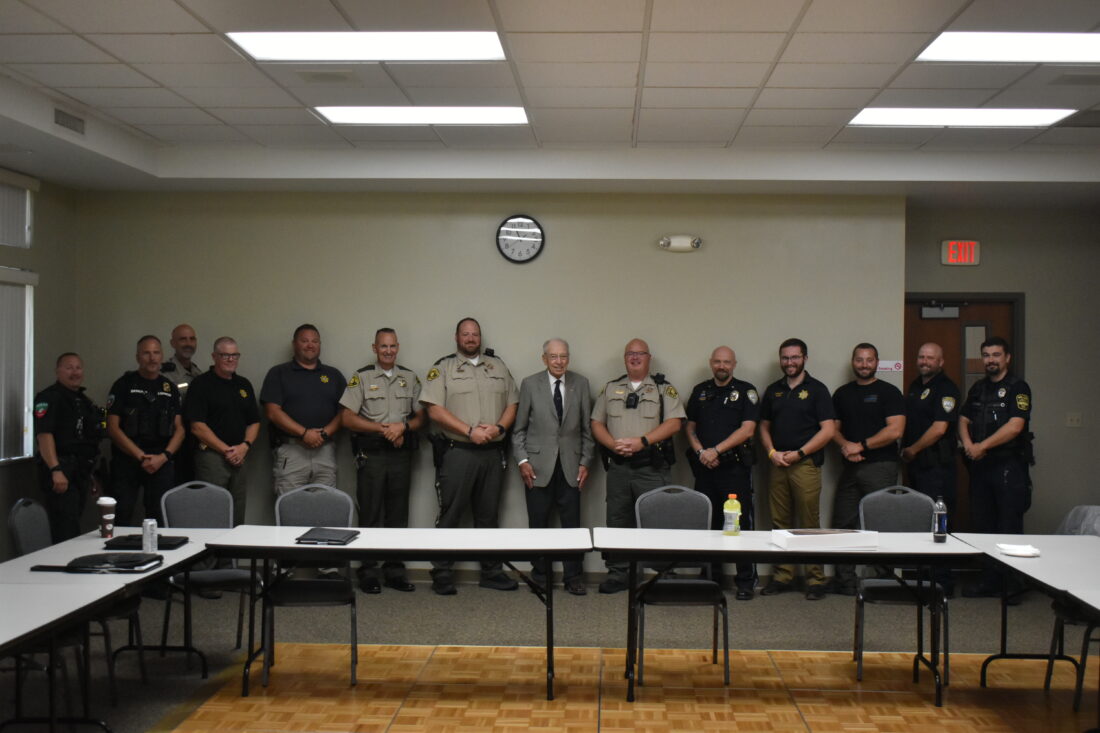
At the conclusion of the meeting, Grassley posed for a picture with members of Tama, Poweshiek, Jasper and Iowa County Sheriff's Offices, along with Meskwaki Nation, Tama and Toledo police officers. PHOTOS BY JONATHAN MEYER
Rural law enforcement officials from across central Iowa used a roundtable with U.S. Senator Chuck Grassley (R-Iowa) last Thursday to raise concerns about mental health services, staffing, grant access, state policy, and the growing number of responsibilities falling on small departments.
Grassley met with representatives from sheriff’s departments in Tama, Poweshiek, Jasper and Iowa counties, along with Meskwaki Nation, Tama and Toledo police officers, Aug. 27 at the Reinig Center in Toledo.
Rather than arriving with a set list of talking points, Grassley told those gathered that he wanted the officers to direct the discussion.
“The agenda is yours, not mine,” Grassley said.
The conversation started with concerns about federal grant funding and the difficulty small departments face competing with larger agencies that employ dedicated grant writers.
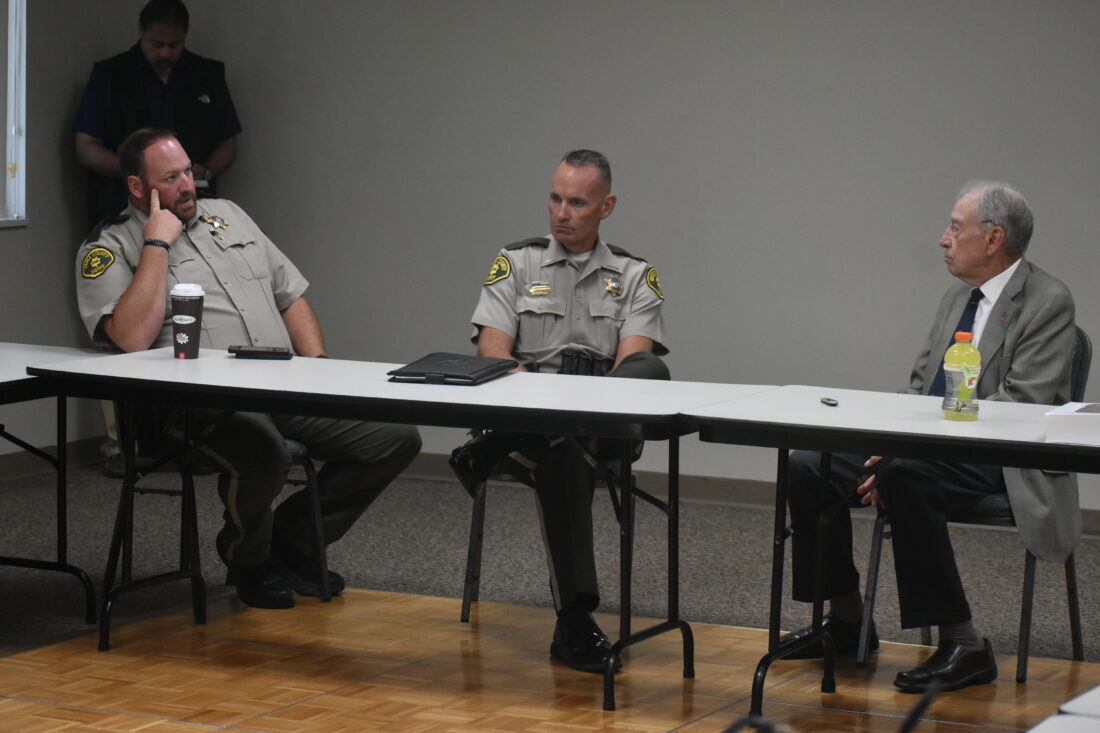
Tama County Sheriff Casey Schmidt asks Senator Grassley about Federal Grants and how red tape could be removed in order to best serve rural departments.
Tama County Sheriff Casey Schmidt asked whether the process could be simplified for rural departments where the same personnel responsible for seeking grants are also handling investigations, administrative duties, patrol calls, and other responsibilities.
For larger agencies, Schmidt said, pursuing grants may be the primary responsibility of one employee or an entire department. In rural Iowa, finding time to complete lengthy applications can be another task added to an already full workload.
Schmidt added that federal grants could become increasingly important for equipment, training, recruitment and retention.
“It’s getting harder and harder to recruit and retain,” Schmidt said.
Grassley acknowledged that the federal government has no shortage of red tape and offered to help connect local departments with staff from the Senate Judiciary Committee and U.S. Department of Justice to explore ways small agencies could better navigate available programs.
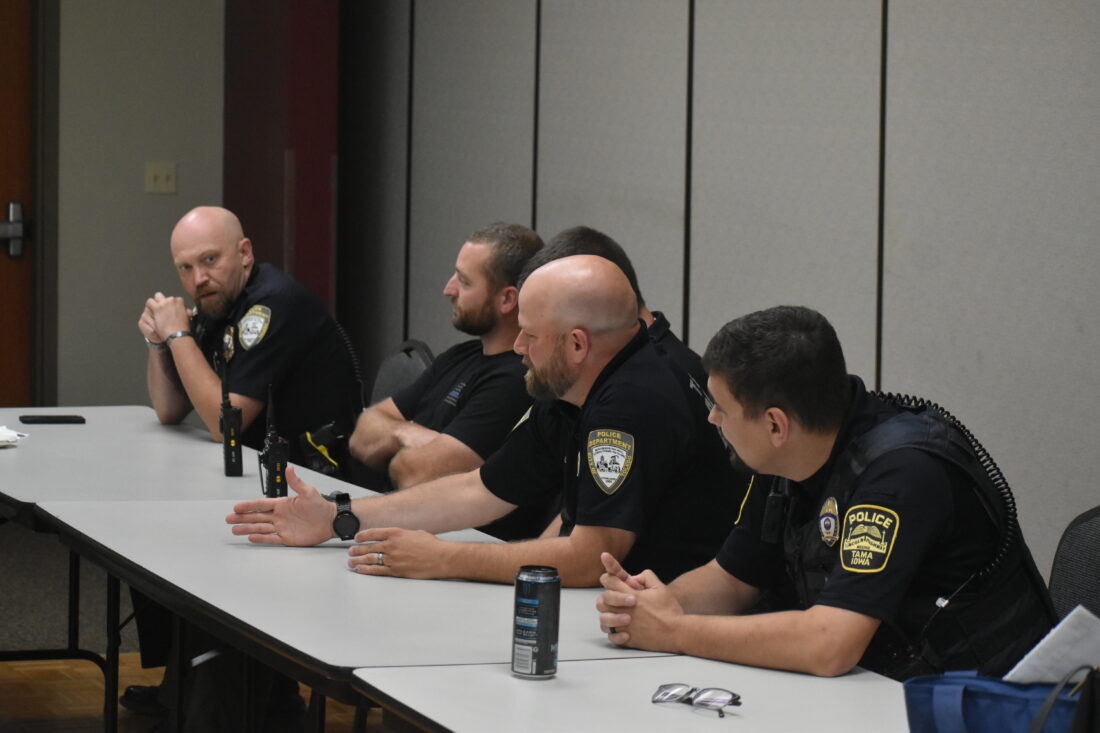
Grassley also told the group that roughly $37 million in federal public safety funding was headed to Iowa.
From funding, the conversation quickly moved into what became the dominant topic of the meeting – mental health.
One sheriff told Grassley that two people in his jail at the time of the meeting should instead be receiving treatment in a mental health facility.
“We’ve got two in our jail right now that shouldn’t be there,” he said. “We have no place to send them.”
Officials around the table described similar experiences, saying county jails are increasingly serving as makeshift mental health facilities because other options are unavailable.
Schmidt said Tama County is no exception.
“I’ve always said the best mental health facility in Tama County is the Tama County Jail,” Schmidt said.
Inmates can receive mental health treatment through telehealth while being continuously monitored by corrections staff, Schmidt said, sometimes making jail one of the few places where an individual in crisis can consistently receive services.
That can also lead to longer jail stays.
For sheriffs already dealing with limited jail space, the result can be beds occupied by individuals whose primary need is treatment rather than incarceration.
Officials said the problem extends beyond county jails.
Patrol officers are often the first people dispatched when someone is experiencing a mental health crisis, even when no crime has occurred.
“We’re the first ones people see in any call that we go to,” Schmidt said. “There’s a lot of times where we have to be the mental health counselor, even though I don’t want to be a mental health counselor.”
For small police departments, waiting for specialized help can also pull a substantial portion of the department out of service.
Interim Tama Police Chief Tyler Ayala-Pagan said a regional mobile crisis team based in Waterloo may take as long as two hours to respond, if the call is accepted at all. In a community where only one or two officers may be working, sitting with a person in crisis for several hours can leave few resources available for another emergency.
Several officials questioned whether Iowa’s move toward regionalized mental health services has actually improved access in rural areas.
Schmidt described Tama County as a “poster child” for agencies that say they serve a county but may not provide services there with the same frequency or availability found in larger communities.
“When they regionalize everything, it’s great in theory,” Schmidt said. “But there’s always the smaller populated counties that are just part of the region but don’t receive the services that larger communities do.”
Grassley said provider shortages remain one of the largest obstacles. The federal government can provide money and encourage different approaches, he said, but it cannot simply create more psychiatrists, psychologists and other mental health professionals.
He pointed to expanded telehealth access as one way the federal government has attempted to stretch the reach of limited mental health providers.
The broader conversation about regionalization prompted Toledo Police Chief Dan Quigley to voice frustration with what he sees as a gradual erosion of services and influence in rural Iowa.
Quigley pointed to everything from mental health resources to magistrates and other government services becoming increasingly regionalized or based farther from the communities they serve.
Quigley also vented frustrations with the state legislature and ever changing laws regarding funding, voicing dissatisfaction with discussions he’s had with his own representatives.
Grassley encouraged those in attendance to continue communicating with their state lawmakers despite the frustrations expressed around the table.
The discussion then returned to ways local departments are attempting to manage mental health calls with their existing resources.
Schmidt said Tama County recently added a full-time mental health liaison using opioid settlement funding.
The program is still being developed, he said, but the goal is to have someone who can help with jail diversion, follow up with individuals after mental health calls and potentially respond to crises where the presence of a uniformed officer could escalate the situation.
“Just law enforcement showing up is an escalation in and of itself,” Schmidt said.
He said there are circumstances where officers are dispatched despite no crime having been committed.
“There are calls that we go on that we really have no business going on, because either a crime hasn’t been committed or somebody is just in a crisis,” Schmidt said.
The liaison can potentially bridge that gap, offering assistance while allowing deputies and officers to return to law enforcement duties.
Other officials described similar programs in surrounding counties, although the availability and structure of those services varies considerably.
The conversation also touched on juveniles, with Tama County officials describing the difficulty of finding appropriate placements for young people experiencing serious behavioral or mental health problems.
One official recalled officers spending hours trying to find a placement for a 12-year-old runaway because available agencies either could not accept the child or did not provide the needed level of care.
Even after a placement is found, officers said, some facilities are not secure enough to prevent a juvenile from running away again.
As the meeting continued, officers shifted to another growing demand on local staff — open records requests.
Officials stressed that they support public transparency but said departments are increasingly receiving requests that appear to come from companies gathering contract prices and purchasing information for commercial databases.
Other requests involve body camera footage and records from high-profile criminal cases.
A Poweshiek County official said the sheriff’s office continues to receive requests connected to the 2018 murder of University of Iowa student Mollie Tibbetts, including from media companies looking for previously unreleased material.
Schmidt said Tama County has received hundreds of records requests connected to a recent homicide.
His concern, he said, is not eliminating access to public records but whether agencies should be able to verify who is requesting sensitive information.
“I’m by no means advocating for less accountability and less transparency,” Schmidt said.
Under current Iowa law, he said, agencies generally cannot require a requester to identify themselves.
Schmidt questioned how that fits with growing concerns surrounding data privacy, particularly when requests could include body camera footage recorded inside a private home.
“How do I know that information that I’m sending isn’t being sent to China, India, wherever?” Schmidt asked.
Grassley said the issue was largely unfamiliar to him but appeared worthy of further consideration.
By the end of the roundtable, Grassley said the discussion had provided him with information about state and local challenges that he had not previously understood in detail.
For the law enforcement officials gathered in Toledo, the individual topics varied, but much of the discussion returned to the same theme: Rural departments are frequently being asked to fill gaps left elsewhere, whether that means providing mental health care in a jail, responding to crises without specialized personnel, finding outside funding or handling growing administrative demands with limited staff.
Grassley thanked the officers for the discussion and encouraged them to continue contacting his office with concerns.
“I hope you feel comfortable doing what I said, letting me know your opinion from time to time and expect an answer,” Grassley said.
Local News
Southern comfort
‘Homespun’ to visit on Oct. 25
TOLED0 — First Presbyterian Church of Toledo will host "Homespun," a gospel Country and Blue Grass musical family ...

Environmental risk factors for cancer presented during meeting in Toledo

Meet the Iowa House District 53 Candidates: Berleen Wobeter
Snapping Right Through
The Tama City Council meeting started by snapping through agenda items left and right. They started by hiring a new ...