

East Marshall hosts legislative dinner with lawmakers, school leaders
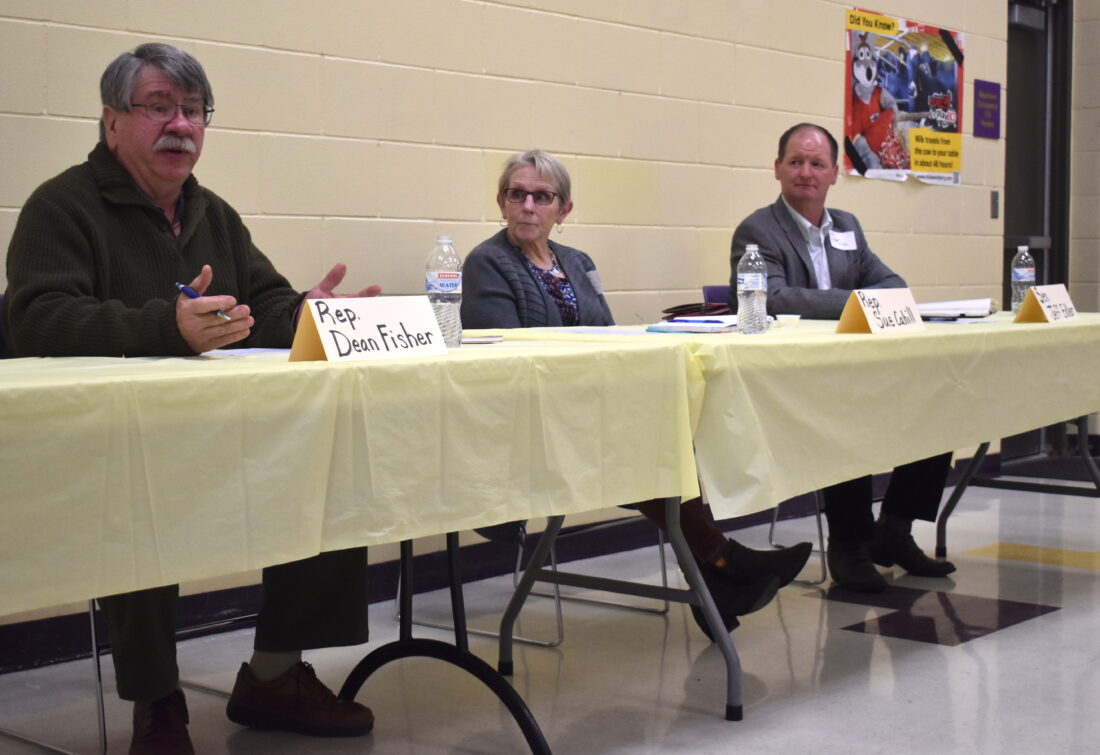
From left to right, Rep. Dean Fisher (R-Montour), Rep. Sue Cahill (D-Marshalltown), and Sen. Jeff Edler (R-State Center) were the featured guests during a legislative dinner held at East Marshall High School on Wednesday, Dec. 7. T-R PHOTO BY ROBERT MAHARRY
LE GRAND — Three area legislators met with administrators and school board members from Marshalltown, East Marshall, and South Tama for dinner and a policy-related conversation at East Marshall High School in Le Grand on Wednesday, Dec. 7.
After enjoying a salad, prime rib, and a baked potato served by East Marshall Honor Society students, those in attendance settled in to hear from Rep. Sue Cahill (D-Marshalltown), Sen. Jeff Edler (R-State Center), and Rep. Dean Fisher (R-Montour). East Marshall Superintendent Tony Ryan introduced the trio, and each took the time to share information on their backgrounds and committee assignments in Des Moines.
During his initial remarks, Edler shared enthusiasm for the chance to hear from administrators and school board members on the issues that mattered to them — some, as he put it, they would agree wholeheartedly on, and others less so. It didn’t take long for perhaps the most controversial school-related topic in Iowa to come up, as Marshalltown Community School District Superintendent Theron Schutte asked the legislators about the aims of the newly formed Education Reform Committee.
Cahill said she believed it was established to work on the governor’s priorities, even if she doesn’t agree with all of them, and Fisher opined that it would in all likelihood deal with parental choice in education — widely known as vouchers or scholarships for students to receive instruction in a private or homeschool setting.
“There’ll certainly be some give and take and strong discussions regarding those pieces,” Cahill said.
Edler called himself a supporter of both public and private schools and added that he hoped they could work together and complement each other rather than competing and fighting over state dollars.
“There are responsible parents out there, obviously, who want or recognize they have a child that needs something different than the typical public school. Whether or not the state’s paying for that, I think that’s probably the biggest issue, and when it comes down to money instead of what’s right for the child, that’s where I get a little worked up,” Edler said. “So I’m trying to find where there can be collaborative efforts between public and private because I support both. They’re both necessary. They’re both good. How do we work together instead of butting heads all the time to do what’s right for Iowa kids?”
Schutte then followed up with a question about whether Edler and Fisher, who have expressed support for the proposed education reform package, would also favor holding private schools to the same level of accountability as their public counterparts.
Fisher responded that he would like to give public schools more flexibility and reduce regulations to allow for more local control of education, and Edler said “every carrot” public school districts received came with more red tape.
Cahill, a recently retired educator who taught in the MCSD, defended public schools and praised them for serving “all children as they come.”
From there, the group segued into other topics, including behavioral issues in schools and the impacts of a new open enrollment law removing the filing deadline, and East Marshall Elementary Principal Cathy DeBondt worried that students who are constantly changing districts can struggle to acclimate and get the education they deserve. Schutte also discussed struggles to hire staff amidst nationwide shortages.
Another hot-button issue in the education world is the prevalence of social media use among students and its impacts on mental health and bullying, and Edler brought it up during the discussion of student behavior.
“The ability to destroy a reputation and a kid’s life right now can happen in a split second because of social media. All it takes is one picture of one compromising position they put themselves in, maybe not even knowing they were in it, and that’s all it takes,” Edler said. “That’s what we have to try and make policy around. How do we try to protect the kids of Iowa while still trying to maintain Constitutional values? It is a very, very jagged line right now.”
East Marshall School Board member Elizabeth Crandon asked about freeing up categorical funding to spend money more freely to address needs. As the conversation shifted back to the workforce shortage when fellow East Marshall Board Member Terri Hungerford asked how to get more people into the field, Cahill lamented the fact that even with a four-year degree, many teachers are only starting at salaries around $45,000, noting that new police officers can make nearly twice as much with a high school diploma.
Cahill also took aim at legislators who she felt had demonized teachers over the last few years and hoped they would be more valued in the future.
“Being a teacher in the last couple of years, I really felt pretty beat up by attitudes within our communities,” she said. “I feel there are some ideologies out there that have vilified teachers and are doing that without substance.”
Edler and Fisher touted tax reform as a driving force in recruiting new residents to work and retire in Iowa, and Edler said he believed one of the biggest factors hurting teachers was the way stories were being reported in Des Moines, citing the example of a proposed bill to place cameras in classrooms that he did not feel ever had a reasonable chance of passing.
MCSD Director of Instruction Shauna Smith asked the legislators to have “vision” and continue to fund programs that will allow high school students to train to become paraeducators and teachers after federal ESSER dollars expire. Smith said seven of the nine students currently participating are bilingual Latina women, and she would hate to see their dreams crushed by factors beyond their control.
“They’ve never been told that this is an opportunity that they can take on, so I just want to tell you how appreciative we are, and I can see them working long-term in the Marshalltown community, having children, and continuing to grow their families and watching Iowa prosper for many years to come,” Smith said. “It would be something that could truly make a difference long term in the state of Iowa if we could continuously fund and support a grow-your-own program.”
Before the night wrapped up, Crandon mentioned the childcare shortage in Iowa, especially in light of the recent closure of one of Marshalltown’s largest facilities.
The legislators and educators concluded by praising each other for their efforts, and Schutte thanked Cahill, Edler, and Fisher for always showing up even if they don’t always see eye to eye on every issue. The legislators, in turn, encouraged those in attendance to reach out to them with questions and concerns.
“I really appreciate the ability to have these open discussions, being able to agree to disagree (and) to not take them personally and to try to move on and try to figure out better ways to meet the needs of everybody,” Schutte said.
Ryan said he plans to host the event again next year on the first Wednesday in December.
Local News

Chelsea park project comes to fruition with strong community support

Breaking ground on future memories
Tama council finalizes joint police department agreement
This week’s Tama City Council meeting started with an update on a nuisance property, and they decided to extend ...

Elberon man gets six-year federal sentence for illegal gun possession

MSS 2026 Homecoming Court announced
