Property sold, students parents and teachers speak, old middle school bidder reveals plans
This week’s STC school board meeting
- PHOTO BY JONATHAN MEYER – High school science teacher Audrey Roth addresses the board during public comments. Over 40 members of the public filled the boardroom to engage in the open floor. Speakers included students, teachers, staff, and parents speaking about recent concerns.
- PHOTO BY JONATHAN MEYER – Steve Emerson gave a presentation detailing what he intends to do to the old middle school if his bid is accepted. Emerson bid one dollar on the over century old school.
- PHOTO BY JONATHAN MEYER
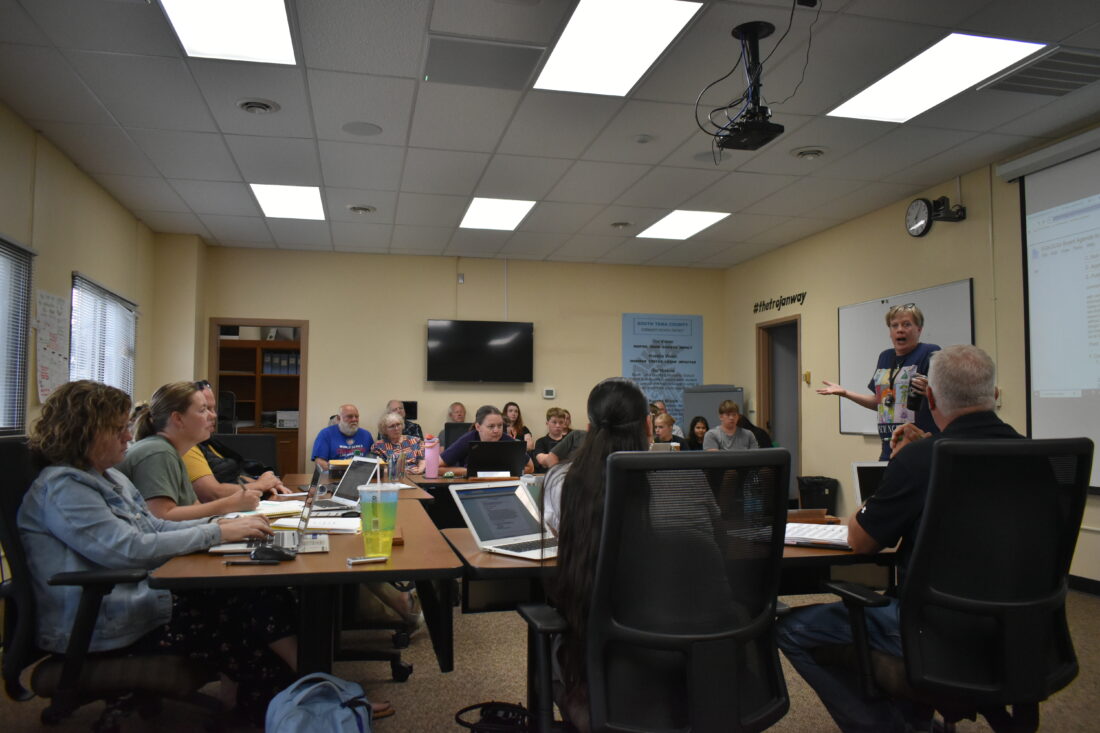
PHOTO BY JONATHAN MEYER – High school science teacher Audrey Roth addresses the board during public comments. Over 40 members of the public filled the boardroom to engage in the open floor. Speakers included students, teachers, staff, and parents speaking about recent concerns.
In a jam packed meeting, the STC School board hosted a busy public comment section, heard plans of redevelopment for the old middle school, sold three properties, and approved administrative and director raises.
At the beginning of Monday night’s meeting, the board held a series of public hearings regarding the proposed sale of several district-owned properties in Tama and Toledo. Much of the discussion centered around bids submitted by H&H Housing LLC, which, through questioning, was revealed to have connections to board member Rick Hopper.
H&H had placed bids on the Tama lot (near Family Dollar), the tennis courts and green space in Toledo, and the old football field in Toledo.
Kristin Donald and Karen Murty questioned Hopper and district officials about the intended use of the properties, accountability for future development, and whether the purchase created a conflict of interest due to Hopper’s position on the school board.
The question was asked what the land would be used for and whether any plans had been formally disclosed. Hopper later addressed the board and public directly, explaining that he had spoken with Toledo Mayor Brian Sokol about potentially preserving portions of the land as green space or allowing the city to lease some of the property temporarily while future plans are developed.
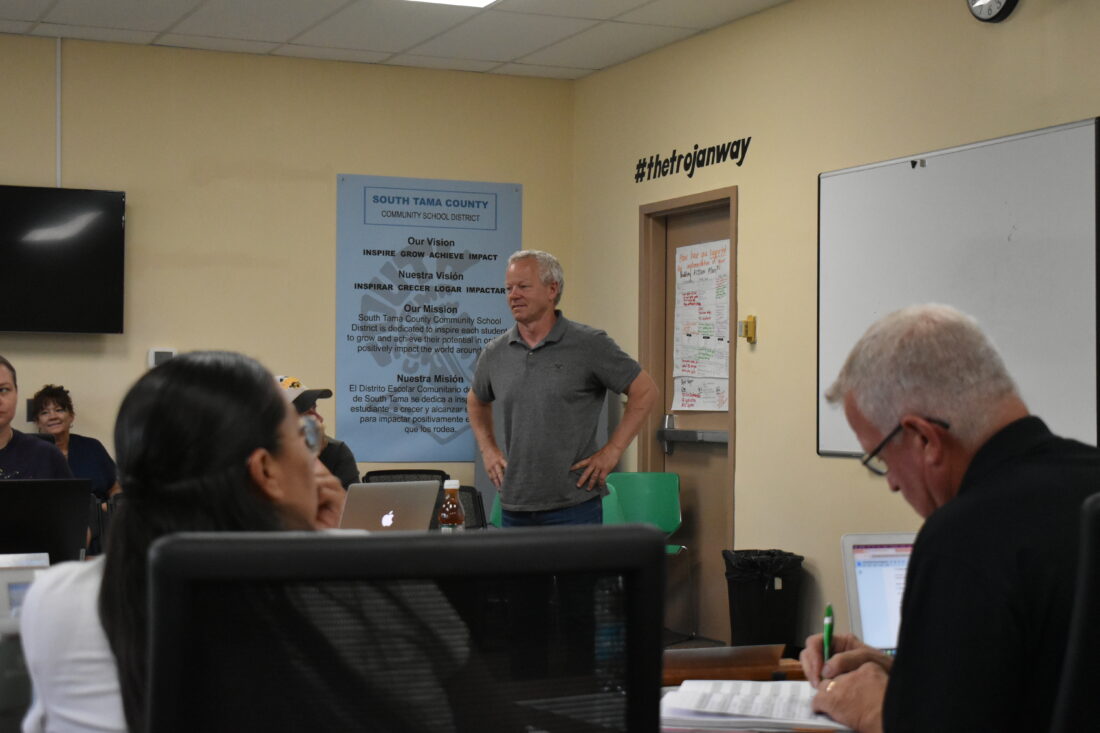
PHOTO BY JONATHAN MEYER – Steve Emerson gave a presentation detailing what he intends to do to the old middle school if his bid is accepted. Emerson bid one dollar on the over century old school.
Hopper said his long-term interest would be to potentially build housing on the properties.
“I’ve also, in the same conversation with Mayor Sokol, talked about the city potentially being interested in leasing that property from us for a nominal fee for a couple years until they decide exactly what they want to see with it,” Hopper said.
Questions were also raised regarding whether the district should sell property without knowing exactly what development may occur on the site. School Board President Elizabeth Dolezal responded that they felt comfortable with the proposal due to Hopper’s local presence and history maintaining properties in the community.
“With it being someone locally who has a number of different properties around the community that are maintained appropriately, that wasn’t something that we felt we needed to pursue further,” Dolezal said.
Another question around on whether the purchase represented a conflict of interest because Hopper currently serves on the school board. Cain stated the process had been publicly advertised and noted Hopper would abstain from voting on the matter.
PHOTO BY JONATHAN MEYER
“It was a fair bidding process,” Cain said. “When it comes time to vote, Rick will abstain from the vote, so he’s not involved in that sense.”
Discussion continued during the hearing regarding the old football field property. Hopper told attendees he has explored the feasibility of future residential development on the site.
“We own 20 units already,” Hopper said. “We’d just be expanding on that.”
Later in the meeting the board approved the sale of the three properties to H&H Housing LLC, with Hopper abstaining from all three votes.
When the board entered its regular public comment period, the tone of the meeting quickly shifted as parents, students, teachers, and staff members packed the room with concerns surrounding safety, discipline, communication, and leadership at the middle school.
The first speaker during public comment was Jamie Koster, who addressed the board regarding disciplinary concerns involving a middle school student she said had repeatedly threatened and intimidated other students including her child.
Koster referenced a letter she previously sent to Cain and argued that incidents involving the student should have resulted in stronger disciplinary action under the district’s handbook policies.
“The student looked at (name of her middle school student) in the face and said, ‘I’m going to kick your butt and shoot you,'” Koster told the board. “Students are afraid of this student, joking or not, it was a threat.”
Koster cited sections of the student handbook related to threats, fighting, suspension procedures, restorative practices, and law enforcement notification, questioning whether policies were being consistently followed and whether incidents were being properly documented.
She also expressed frustration over public statements made earlier this spring that characterized some threats as rumors before students had been interviewed.
“After the administration made the public comment that the threats were rumors before any students involved were interviewed, is absurd,” Koster said.
Koster added that if more action was taken, middle school students might not have been assaulted.
Koster urged district leadership to take stronger action before future incidents escalate further.
“Expulsion may look bad on your state reports,” she said, “but being on national news would be worse.”
Following comments from Koster, Patience Petty, an eighth grade writing teacher at the middle school, addressed the board regarding staff morale, communication, and her experience as a first-year teacher in the district.
Petty said consistent coaching and support are essential for new teachers, but described the support she and other first-year staff members received this year as “limited and inconsistent.”
“As the year progressed, concerns regarding communication, workloads, changing expectations, and lack of support continued to grow,” Petty said. “Many staff members felt their professional knowledge and classroom experience were not valued.”
Petty told the board that relationships between staff and administration declined throughout the year as expectations increased without what she described as adequate support.
“I expressed concerns that the environment no longer felt supportive and welcoming as it had during my student teaching experience under previous administration,” she said.
Petty also described concerns surrounding her employment status for the upcoming school year. According to Petty, she was asked to submit her resignation before the district’s contractual deadline and felt pressured after being informed she would otherwise be asked to sign documentation stating she would not be recommended for a future contract.
“After finding that document placed on my desk, I felt pressured to submit my resignation out of concern for my professional future,” Petty said.
She additionally claimed that after resigning early, she was informed future leave requests could be denied without pay despite still having more than 70 hours of accrued leave remaining.
“Situations like this damage trust, lower staff morale, and discourage employees from remaining in or applying to the district,” Petty told the board.
Petty ended by saying she decided to speak publicly despite fears of retaliation because she believed it was important for the board and community to better understand the challenges affecting staff morale and retention within the district.
A large group of middle school students addressed the board with concerns surrounding school safety, student discipline, communication from administration, and overall school climate during the past school year.
Because many of the comments involved minors discussing sensitive disciplinary and safety matters, the News Chronicle is choosing not to identify the students by name.
Throughout students repeatedly described feeling unsafe at school following reported threats, fights, and altercations involving other students. Several students said they felt concerns raised by students and teachers were not always taken seriously or addressed consistently by administration.
Students also raised concerns about what they described as inconsistent discipline and favoritism, claiming some students appeared to receive different treatment or consequences depending on the situation. Multiple speakers said they believed positive student behavior and leadership were often overlooked while students frequently involved in behavioral issues received the majority of administrative attention.
A number of students focused specifically on a recent locker room assault and earlier reported threats made by another student. Several speakers told the board they felt communication with students and families during those situations lacked clarity and reassurance, leading to fear and uncertainty throughout the middle school.
Students additionally criticized comments allegedly made to girls following the locker room incident, saying many students felt blamed for not physically intervening during the altercation.
Beyond safety concerns, students also discussed frustrations surrounding fundraising and activity planning. Eighth graders questioned why money raised for class activities was later redirected toward other purposes without student input after students had worked to organize and promote fundraising efforts.
Despite the seriousness of the topics discussed, several board members later commended the students for speaking publicly and advocating for themselves and their classmates during the meeting.
Jeanette Stacey told the board she has served the district for 27 years and has worked under multiple principals and superintendents during that time. While disagreements had occurred throughout her career, Stacey said she had generally experienced professional and respectful communication until this school year.
“This year, however, I’ve become increasingly concerned about the lack of communication and the professional climate within our building,” Stacey said.
According to Stacey, concerns she raised through the district’s chain of command ultimately resulted in what she described as increased scrutiny toward both herself and the middle school special education department.
“Despite having a long history of positive evaluations and professional trust, these concerns continued,” Stacey said. “I experienced repeated questioning of my professional judgment and expertise.”
Stacey told the board she eventually stepped away from several leadership responsibilities she had held for years because of concerns surrounding the work environment and her ability to continue functioning professionally within it.
Shortly after Stacey spoke, fellow special education teacher Stacy Moore addressed the board, describing this year as the most disheartening of her 19-year career in the district.
“I have never felt so disrespected and unlistened to,” Moore said. “In my entire career, I have never had to go all the way up the chain of command to the superintendent until this year.”
Moore said teachers’ professionalism and abilities had repeatedly been questioned and criticized, sometimes in front of students.
“You don’t reprimand staff in front of students,” Moore said. “If you have a problem with me, fine, but you don’t do that in front of the students.”
Moore also defended paraprofessionals and support staff members working in special education classrooms, saying maintaining a united front among staff is critical when working with students.
“If I had more than one year left, I would not come back,” Moore told the board. “I stayed because I liked it here. This year has been very disheartening, beyond words can say.”
Ashley Steven also addressed the board Monday night, speaking both as a district employee and as the parent of a middle school student.
Steven described a meeting she had with middle school administration following reported threats involving students earlier this spring, calling the professionalism during the conversation “horrible.”
“The professionalism during that meeting was horrible,” Steven told the board. “It turned into a very quick blaming argument.”
Steven said she chose to remain quiet during the meeting despite concerns because she felt uncomfortable with how the conversation unfolded.
As both a parent and educator, Steven said the situation became especially difficult after her son began asking questions about the threats and violence being discussed at school.
“This is when I got concerned,” Steven said, recalling her son asking what it meant to “be shot up and turned into Swiss cheese.”
Steven also told the board she previously left the district before eventually returning because of her belief in the middle school and the relationships she had built there. However, she said this year’s environment ultimately pushed her toward transferring to the high school sooner than she originally planned.
“The lack of professionalism, communication, and how this school has been run here, it was forcing,” Steven said emotionally. “I feel very sad in saying that because I think I’ve made some very positive progress for my students.”
Steven added that she believed many teachers were afraid to speak publicly because of fears surrounding retaliation or job security.
“I want you guys to really understand this isn’t an impression that’s happening because of one issue,” Steven said. “If you asked any of these teachers last year or students last year, they would say the middle school had the best climate.”
Ryan Cassidy, a middle school physical education teacher, also spoke during public comment, raising concerns about supervision and safety in the girls locker room.
Cassidy told the board he had raised concerns with administration earlier in the school year regarding the need for a female staff member to help monitor the locker room areas while he and fellow PE teacher Mr. Tapia supervised classes.
“I instantly, Monday morning after the occurrence happened Friday at the locker rooms, I went straight to ask, can we please have a female staff member to at least look in the mornings,” Cassidy said.
Cassidy explained that he and Tapia were uncomfortable entering the girls locker room themselves and did not want to risk putting themselves in inappropriate situations.
“I have no idea what the females are doing in the locker room,” Cassidy said. “I am not going to risk my position.”
According to Cassidy, administration responded by saying the issue would likely be looked into next year, which he said left him frustrated given recent incidents connected to the locker room area.
“So now I’m just spending day-by-day basis wondering what’s happening still in the locker room and what can I do about it,” Cassidy told the board.
Following Cassidy’s comments, Stacy Moore added that the district had historically assigned female staff members to supervise the girls locker room prior to staffing changes in recent years.
“It is not a new concept,” Moore said. “We have always had a female staff member to be able to go into that locker room for safety issues.”
Audrey Roth, who teaches high school science, directly apologizing to students who said they no longer feel safe at school.
“I’m sorry that you can’t feel safe this year,” Roth told students attending the meeting
Roth directed comments toward staff preparedness and training during violent incidents at school, saying teachers are not always clearly instructed on how they are expected to respond during fights or emergencies.
Drawing from previous teaching experience in another district with multiple security personnel, Roth said clearer expectations and procedures need to be established for staff members.
“When we onboard our teachers, when they’re coming in, we need to let them know, ‘This is what you can do if you feel comfortable,'” Roth said.
Roth added that situations involving fights and student safety cannot continue without changes in training and communication.
Dixie Forcht addressed the board as president of the South Tama County Education Association, focusing her comments on communication concerns between district leadership and the teachers union.
Forcht shared with the board that multiple labor-management meetings with Superintendent John Cain had been canceled throughout the last few months, limiting opportunities for staff concerns to be addressed collaboratively.
“For the last five meetings, Mr. Cain has canceled our meetings for labor management,” Forcht said.
According to Forcht, the canceled meetings prevented concerns raised by teachers and staff from reaching the board earlier through normal channels.
“I feel like he might have been able to know about some of these things and that you guys know about them in advance had he met with the association for labor management meetings,” Forcht said.
Forcht said she had hesitated to bring concerns directly to the board because she did not want to violate the district’s chain of command procedures.
“I am taking a risk right now by standing up and letting you know that I have not come to you before now,” Forcht said.
She added that she had spent much of the year listening to concerns from staff members and attending meetings at the middle school regarding workplace climate and communication issues.
Board president Elizabeth Dolezal thanked those who spoke and acknowledged the seriousness of the concerns shared throughout the evening.
“There’s a lot of information to process tonight,” Dolezal said. “We will be having a lot of conversations about this.”
While noting the board could not immediately deliberate on issues raised during public comment because the topics had not been formally listed for board discussion, Dolezal emphasized that the stories shared would not be ignored.
“I want to thank everyone who took your time to come and speak on behalf of your peers, your students, your children, your teachers, your coworkers,” Dolezal said. “This means a lot.”
MIDDLE SCHOOL PRESENTATION
A potential buyer for the former South Tama County Community School District middle school presented an extensive redevelopment vision to the school board Monday night, outlining plans to convert the vacant building into workforce housing while preserving much of the historic structure.
Developer and architect Steve Emerson addressed the board following Monday night’s public comment period, introducing himself and sharing examples of previous redevelopment projects completed throughout Iowa.
“I’m an architect by trade and a developer by accident,” Emerson said with a laugh. “Because of COVID and a lot of empty facilities, we got into adaptive reuse of historic buildings.”
Emerson’s proposal would involve purchasing the former middle school building for $1 and converting it into multi-family housing focused on workforce and family residents rather than traditional low-income housing.
The project would likely utilize a combination of historic tax credits, workforce housing incentives, and Brownfield funding programs through the state of Iowa and federal preservation agencies.
Throughout the presentation, Emerson showed photographs and floor plans from previous projects, including converted schools, hospitals, and commercial buildings in communities such as Cedar Rapids, Boone, and Nevada.
Among the projects highlighted were a former Cedar Rapids warehouse converted into apartments following the 2008 flood, a historic hospital redevelopment in Nevada, the Page Elementary and Lincoln Elementary redevelopment projects and several mixed-use housing developments in Cedar Rapids.
Emerson said the former South Tama middle school stood out because of its strong structure and surrounding neighborhood.
According to Emerson, the current concept would focus on creating larger two, three, and four-bedroom apartments intended for families, aging residents looking to downsize, and workers employed locally who currently struggle to find housing options in the area.
“I’d rather try to find families that either have kids, grown kids, or they want to downsize,” Emerson said. “Potentially families that work at the meat plant and have to travel here because there’s no housing opportunities.”
Emerson stressed repeatedly that the goal would not be luxury housing, but instead quality market-rate units that remain financially attainable for local residents.
“The purpose of using the grants like workforce housing is to keep the construction affordable so that when I leave, I have less debt on the building,” Emerson said. “Then I can lease these units at a lower rate that the community can actually afford.”
Proposed plans include: preserving much of the original school structure, adding an elevator, redoing windows, potentially retaining the gymnasium as a community amenity, and using space beneath the gym for parking.
Emerson also said the project would likely require at least a year of planning and approvals before construction could begin, due in part to historic preservation reviews and state funding applications.
“The process to convert a school to multi-family takes a while,” Emerson said. “You have to have your historic designation, your approved design, and then apply for the workforce housing credits.”
During the presentation, Superintendent John Cain and Toledo Economic Development Director Katherine Ollendieck voiced strong early support for the proposal, citing Emerson’s experience and track record completing similar projects across Iowa.
“This feels different,” Ollendieck said. “It definitely has a much better track record.”
Ollendieck also emphasized the housing shortage facing the area and said the city would likely need to play a role in helping support future state funding applications connected to the project.
“We know the need exists,” she said. “Seventy-five percent of our workforce leaves our county because they can’t find affordable housing here.”
Dolezal told the board she was encouraged by Emerson’s willingness to work collaboratively with local government agencies and law enforcement, including allowing emergency personnel to train inside vacant properties during redevelopment planning stages.
The board took no formal action Monday night regarding the sale of the middle school building itself, though district officials said contract discussions are continuing and a formal public hearing could potentially occur later this summer.
Other notable updates
When the agenda item of personnel came up, the board discussed the controversial candidate they are considering for the High School Maintenance/ Custodial position. Hopper mentioned that he had received a few concerned voices on the matter and had talked it over with Cain, and that some of his concerns were put to rest.
Joe Hanus brought up the possible insurance side of things, referring to an SR22, which is a proof of financial responsibility form required by drivers convicted of serious moving violations. Josh Casey is the candidate in question. Casey has been found guilty of multiple charges over the years, including OWI, disorderly conduct, possession of drug paraphernalia, domestic abuse assault, and false imprisonment. The board scheduled a special session meeting on Thursday morning at 8 a.m. to discuss further action with this candidate.
The board decided to return to meetings on the first and third Mondays of the month starting in July.
The board also accepted the resignation of Megan Thiessen, effective the last day of June, and will look to appoint her replacement soon after.
After a closed session, the board took action with Hopper, Keahna, and Dolezal voting in favor of raises for Administrators, Directors, and Coordinators, and the superintendent for the next school year. Joe Hanus was the lone Nay vote.
Raises range from $1,250 to $2,250 and total $26,500 toward said raises.
The meeting which started at 5 p.m. adjourned at 8:56 p.m. The next regularly scheduled meeting is set for June 8 at 5 p.m. in the Partnership Center.
Local News
First Reading: This week’s Tama City Council Meeting
As the Toledo City Council was deliberating and finally approving the establishment of the Tama-Toledo Police ...
1+1=1
There was a moment of trepidation, a moment of thought, when the resolution to join the Tama and Toledo Police ...

Tama County deputy arrested, charged with OWI in Grundy County
Wise lawsuit against supervisors refiled, reassigned to federal court
CEDAR RAPIDS — A lawsuit filed by former Tama County Human Resources Manager and Insurance Administrator Tammy ...

GOP Congressional candidate Joe Mitchell visits Tama-Toledo area last week