

The First National Bank of Montour – Printed money as was the practice
-CONTINUED?FROM?THE?FEB. 12 ISSUE?OF?THE?TOLEDO?CHRONICLE
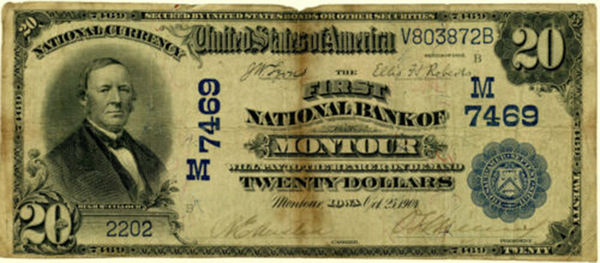
Editor’s Note: Interest in the Montour bank surfaced recently when a $20 bill issued by the bank surfaced on the internet auction site eBay.
The Federal Reserve Bank of Atlanta says “paper currency no longer in circulation includes national bank notes, which national banks, were issued from 1863 to 1935.
Brought to the attention of local historian and retired Chronicle reporter Joyce Wiese, she compiled this history of the Montour bank.
By Joyce Wiese
-Pt II-
In 1863 when it was decided the Cedar Rapids & Missouri railroad (later called the Chicago & Northwestern) was pushing through the eastern part of Tama County, two men with visions of the future, Miron Kellogg and Phineas Helm, purchased a few acres in Section 21 of Indian Village Township, and laid out lots and blocks. They called this Orford. Due to the mixup of the postal department between Oxford and Orford , the name was changed to Montour.
With the town continually expanding it was decided the town needed a bank to handle all the businesses. The Montour Exchange Bank was founded by O.B. Dutton & Son in 1872. This was a 2-story wooden building. In 1873 the bank was sold to Chauncey Stevens, W.H. Harrison and G.H. Warren, who continued the business until 1875 when Stevens became the sole proprietor. In August 1875 he joined with H.J. Stephens and the firm was called C.J. Stevens & Company, continuing until1883, when L. Matthews and George Young purchased the firm and was then engaged in a general banking business under the firm name of Matthews & Young. Matthews & Young had the bank until the early 1900’s.
Before 1900 the town of Montour had great expansion. They now had a lumber yard, post office, furniture store/funeral home, newspaper, two blacksmith shops, machine shop and foundry, a woodworking shop connected with wagons and buggies, a wagon and carriage shop, meat market, physician, drug store, hardware store, grocery stores, depot, elevator two hotels, two restaurants, stockyard, creamery and produce station, and more.
In 1892 due to the business of shipping livestock, a turn table for the railroad was built on the east end of the town near the stockyard. The town had two churches, Congregational and Methodist, and a brick schoolhouse.
Orson Pennington Millard, born in 1848, served in the Civil War with his father Isaac P. Millard. Orson enlisted in Company I, 23d Wisconsin Voluntary Infantry when he was 15 years old. Isaac died on his way home from the Andersonville prison and was buried off the ship in the Red River. Orson was with his father at the time.
Orson, an industrious sort of man, and his brother-in-law Henry Swift built what was known as “The Stone Garage” in 1879. Blocks from the nearby Quarry were hauled to the site and structure was erected by manual labor. The building stood for 100 years when it was destroyed by a tornado. It was called the Lincoln Highway Garage at one time and they sold Maxwell cars.
In 1891 William A. Downs was a proprietor of a machine and foundry shop in the building. The second floor had been used for woodworking connected to wagons and buggies. Downs was a man who could truly be called a genius. When he was 15 years of age he commenced to make toy engines and before he was 19 years of age he had built an engine capable of running considerable machinery. Downs was born in Indiantown in 18158, the son of Thomas L. Downs, Superintendent of the County Schools for four years. He had one sister and one younger brother, T. Nelson Downs, King of Coins.
When Orson Millard opened his blacksmith shop he soon found the need of a lathe and other equipment The use of a lathe would require considerable power. Millard, a man of the future, proceeded to build a large windmill in the rear of his property for power. The windmill was probably the highest and largest in the county at that time. It measured 87 feet high with a base of 1q6 feet 8 inches. Strongly constructed with a wheel of 16 feet in diameter. Mr. Summer Coleman representing the Elgin Centennial Wind Mill Company, constructed the windmill. The estimated cost of the entire outfit was $40. When patrons would bring work in to be done on the lathe they would ask how along it would take, with the standard reply “It depends on when the wind blows”.
Ashes from a fire set by lightning caused many changes. There was considerable damage to the upper story of the Montour Exchange Bank building, as well as several other buildings being destroyed. It was decided to move the building just east of the bank to the next lot, making room to move the bank building to the lot east of where it was standing, leaving the original lot open to build a new brick building. In 1904 the First National Bank of Montour was established as a national institution. The First National Bank had a capital and surplus of $45,000 and deposits of $300,000. This was a modern brick building with a community room in the back for farmers to use for all their meetings.
The First National Bank of Montour printed $372,000 dollars of national currency, a pretty standard output., These were in 6 different denominations. They printed 796 sheets of $20 in 1904. In 1920 printed 178 sheets of $20 and $10.
Recently a Tama County resident produced a copy of a $20 bill issued by the First National Bank of Montour, with printing date of October 24, 1904, and signatures of R.E. Austin, cashier and O.L. Millard, President. This has become a topic of conversation for many of those who had connections with Montour.
Robert E. Austin, when first finishing his education, worked in the First National Bank of Toledo. At this time he married Mabel Ross of Toledo. A little later he served a four year term as deputy clerk of the District Court of Tama County. Mr. Austin served as cashier and manager of The First National Bank of Montour for several years. In 1919 Judge Austin and his two daughters left Montour and moved to California.
Omar Leon Millard was a business man and life long resident of Montour, was a son of Isaac C. and Lydia Swift Millard. Omar was born in Montour and graduated from Montour High School. He had been closely associated with the bank for many years and served as bank president. His father was an early settler in Montour and created several businesses during his life time.
In 1929 another group of bills in $10.00 and $20.00 denominations were printed. These had the signatures of E.R. Cronk, Cashier and Ed Smith, President. Both of these men were active in the bank from its inception and long time residents of Montour. These tow amen were still active when the Great Depression eased into a national emergency, reaching its height between 1932 and 1933. The U.S. Government established several agencies as a means of discharging new and emergency functions. The FDIC was one of the agencies. The Federal Deposit Insurance Corporation is an independent agency created by the U.S. Congress to maintain stability and public confidence in the banks.
When the Great Depression was starting in 1929 many banks were running into problems. The First National Bank of Montour continued to serve those from the Montour area until March 6, 1933 when President Roosevelt declared a banking holiday and temporarily closed all U.S. Banks. President Roosevelt signed the Emergency Banking Act of 1933 on March 9 of that year. This permitted the Office of the Comptroller of the Currency (OCC) to appoint a conservator with powers of receivership over all national banks threatened with suspension.
Eventually most depositors were paid 100% of their deposits. This took several years for the banks to eliminate the assets of the bank and make payment s.
When the Montour Bank closed there was considerable talk amongst the business section of town feeling the town needed a bank. Business men could feel the lack of a bank in their cash income. They pointed out how residents of the Montour trade area who formerly traded in Montour, now go to some other town where there is a bank to do their trading. Every person who had money to deposit or who did business was badly inconvenienced. It seems the group met with the intention of reopening the banks but were outnumbered and Montour lost their bank forever.
The town h ad everything going their way for many years with the railroad going through, the business of shipping livestock, the Lincoln Highway going through town and the proud owners of their own bank, depot, elevator, and many other businesses.
Local News
Helping Tama County thrive

2026 MSS Homecoming Royalty crowned
St. John Lutheran Church to celebrate 150 years Sunday
St. John Lutheran Church will celebrate 150 years on Sunday, October 18, 2026. The church itself had its ...
Chock full of public hearings
This week’s Toledo City Council meeting was chock-full of public hearings. It started with a hearing on the sale ...

For the love of Frankenstein
