Tama County SWCD hosts event highlighting benefits of cover crops
- PHOTOS BY BERLEEN WOBETER The Tama County Soil and Water Conservation District (SWCD) hosted a free program on cover crops at the Reinig Center in Toledo on March 26.
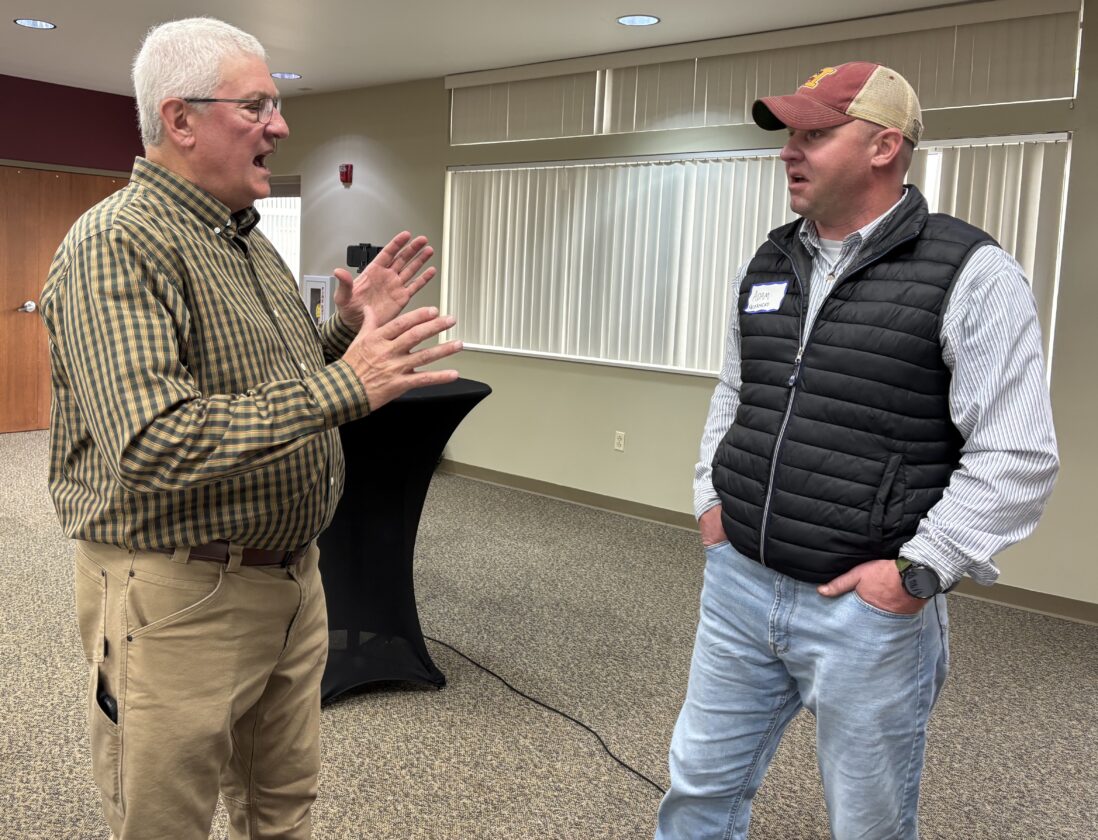
PHOTOS BY BERLEEN WOBETER The Tama County Soil and Water Conservation District (SWCD) hosted a free program on cover crops at the Reinig Center in Toledo on March 26.
Words of warning from a concerned observer predicted financial ruin for Dysart farmer, Al Schafbuch, as he began to introduce cover crop practices on his farm. He was ahead of his time and experimented with the practice long before the idea was fully understood. Two decades later, Schafbuch is regarded as a successful and innovative early adopter of a practice now proven to be beneficial to the farmer’s bottom line and soil health.
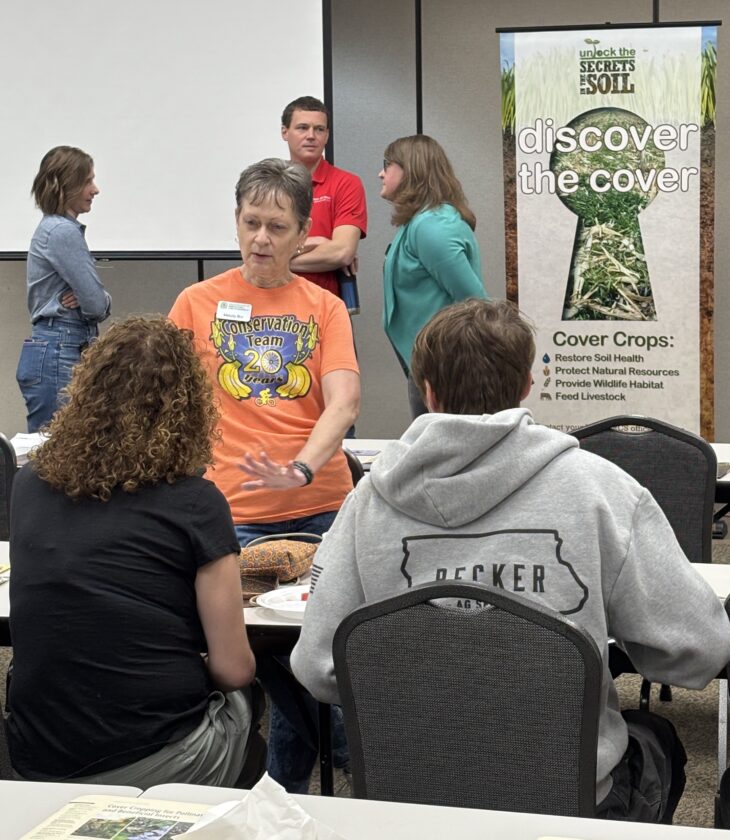
Schafbuch was eager to share his story as forty farmers and interested people from around Tama County and adjoining counties gathered for a free program sponsored by the Tama Co. Soil and Water Conservation District (SWCD) on March 26 at the Reinig Civic Center in Toledo. The program was presented by conservation experts who shared about cover crop management, cost share options, and more. Adam Nechanicky, SWCD assistant commissioner, moderated the day-long event.
Coming from Indiana, Barry Fisher, retired from 39 years working for the USDA-Natural Resources Conservation Services (NRCS), led off the event with his passion and knowledge on the subject during the program titled, “From Seed to Strategy: Intentional Cover Crop Management.”
The basic principles are to disturb the soil as little as possible (no-till) and have continuous living roots which means growing plants (cover crops) before and after the harvest of commercial crops. These practices improve soil health. Soils are an invaluable finite natural resource that need protection. A statement attributed to Franklin Roosevelt in a NRCS Soil Health pamphlet best sums up this concept.
“The nation that destroys its soils destroys itself,” he said.
A break time conversation between Fisher and Mark Nechanicky, a retired farmer from rural Buckingham illustrated how far the debate over the value of cover crops has progressed. From initially asking if cover crops are beneficial, the results of years of studies and testing have proven their benefit.
“Now farmers want to know the answers to ‘what to grow’ and ‘how to grow them’ not ‘if to grow them.’ I wish I could be here in twenty years to see how all this turns out,” Nechanicky said.
Earlier, Schafbuch commented, “Cover crops are the frosting on the cake, they make everything better.”
That “better” is a complex interplay of improved soil health, profitability, increase in pollinators and other beneficial insects plus reduced costs for herbicides, insecticides, and fertilizer. Farmers who plant cover crops have identified their five top reasons for doing so: increased organic matter, reduced soil erosion, reduced soil compaction, weed management and a new source of valuable nitrogen. Cover crops can also be used for grazing and harvested for livestock feed.
Fisher gave a stark example that illustrated how improved soil health through cover crops impacts the environment. Cover crops promote natural biologic development in the soil which creates soil aggregates. These aggregates are made up of individual mineral particles (sand, silt, and clay) all held together with microbial glues, plant roots, and fungal hyphae. What would be visible to the casual observer comparing fields with and without cover crop practices might be witnessed during a heavy rain event.
With cover crop practices the soil aggregates would hold the soil in place, preventing heavy runoff and soil erosion while allowing for significantly improved water infiltration. There would be less water pooling and water that did run off the field would be clearer. The soil structure would mean soils would feel solid and supportive and less spongy to walk on. A clump of soil with aggregate formation holds together when placed in water for testing while other soil would easily separate and filter to the bottom of the container showing how easily these soils wash away. These poor quality soils form islands of thick mud at low points during heavy washing rains.
The journey to soil health is not a quick fix. The process relies on the buildup and protection of soil biology. Initial benefits may be evident the first year while further benefits may take five or more years to achieve. Fisher identified the kind of thought process a farmer needs to go through to successfully implement cover crop management practices.
“This is not like adapting to new technology. This is about asking yourself if this is a core value you hold. A farmer will be changing a living ecosystem and developing an entire new system of management where practices are all complementary,” he said. “This is not a one size fits all, and all decisions are based on understanding how the system works for each specific location.”
To incentivize beneficial change that might otherwise not happen, cost share programs are available through private and public efforts to offset costs associated with new practices or to mitigate the risk of yield loss during a transition phase.
Private companies are motivated by carbon markets to participate in promoting farming practices that pay farmers to sequester carbon defined as the capture of carbon dioxide from the air to lock it in soil underground. A company such as Pepsi can pay farmers as part of their corn syrup supply chain to sequester carbon by a cost share payment to the farmer. Airlines, on the other hand, need to offset their emissions outside their supply chain by supporting specific farming practices. A complex set of rules and restrictions govern how the various cost share programs work and if and when they can be combined for added benefit to the farmer.
For landowners who rent out their land but want to see cover crop management practiced on their land it was noted that lease agreements need to be written with those requirements stated in the lease. Those interested in learning more or wanting to ask questions can stop by the local USDA-NRCS office. Your local NRCS contact is District Conservationist Stacie Buhr at 641-484-2702 ext. 3.
Local News
Tama County audit report released
Eide Bailly LLP recently released an audit report on Tama County, Iowa. Financial Highlights: The County’s ...
Man life-flighted after single vehicle accident Monday
Tama County Community Foundation to Award Over $190,000 in Grants
WHAT: The Tama County Community Foundation is holding their 2026 grant awards celebration. WHY: The Tama County ...
Tama County SWCD hosts event highlighting benefits of cover crops

Feed Me!