

Iowa Environmental Council holds advocacy day at Capitol
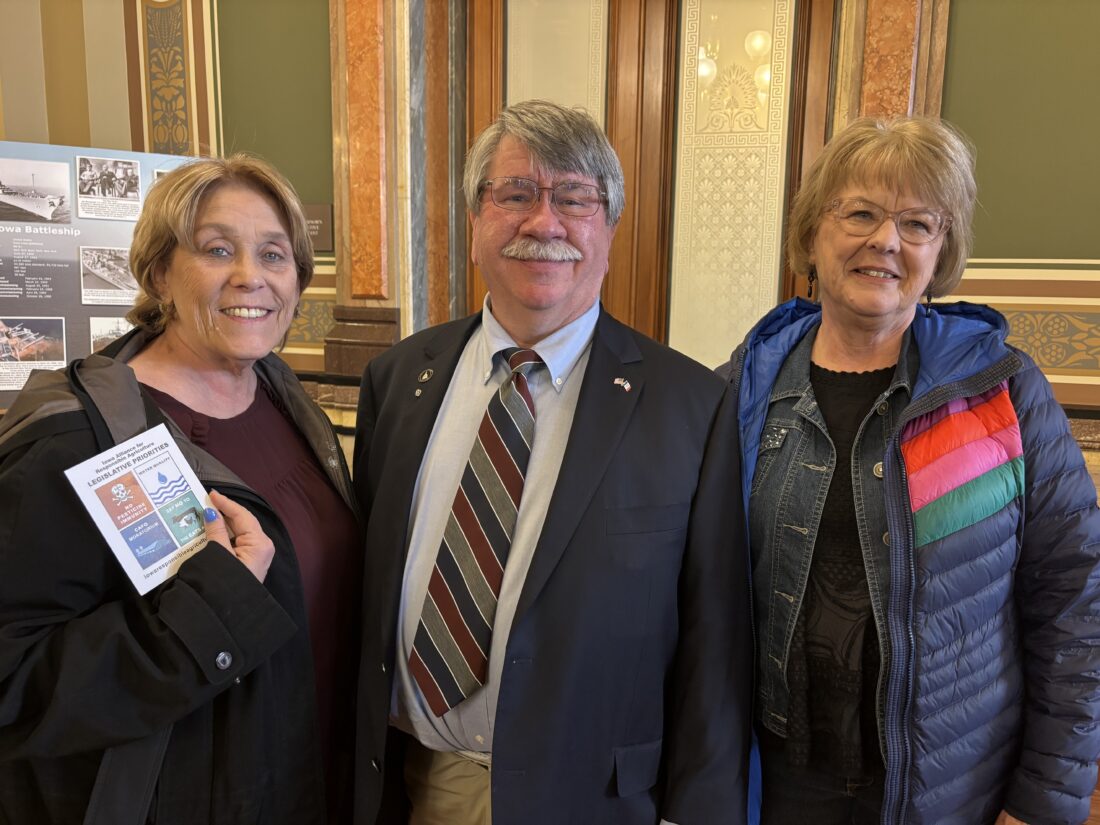
CONTRIBUTED PHOTO From left to right, Nancy Purk of Toledo, Rep. Dean Fisher (R-Montour) and Berleen Wobeter of rural Toledo pose for a photo during the Iowa Environmental Council (IEC) Advocacy Day at the State Capitol building on Feb. 25.
Tackling the complex issue of the relationship between humans and the environment, the Iowa Environmental Council (IEC) held their Advocacy Day at the Iowa State Capitol on Feb. 25. The day consisted of education and training for any interested Iowan during a morning session and an afternoon of speakers, storytellers and displays hosted by 30 IEC Member Organizations. Participants were then encouraged to advocate for IEC’s three priorities with Iowa lawmakers. Those 2026 health and environment priorities are reducing radon exposure, preserving Iowa’s water monitoring network, and protecting Iowa’s health and water from coal plant pollution.
Tama County resident Stephanie BadSoldier Snow was one of several invited afternoon speakers. Snow was raised on the Meskwaki Settlement with traditional Meskwaki beliefs and language.
Snow’s message invited listeners to think deeply about their understanding of love and the reciprocal relationship between themselves and the natural world.
“If love in its definition means you take care of another… means you want your loved one to thrive and be happy… then does the Earth love you?” she asked. “Yes, the Earth loves us, but why is it so hard for us to recognize that love and return care to the natural world?”
Snow’s words described a holistic equal relationship between humans and the Earth where actions have consequences for the long-term well-being of the entire familial system.
One topic of particular concern at this year’s event was Iowa’s ongoing radon problem. The state’s homes have the highest average radon concentrations in the U.S. This colorless, odorless, tasteless gas originates naturally from the decay of uranium content in rocks.
In 1988, radon was identified by the EPA as a carcinogen. Radon is the second leading cause of non-smoking lung cancer deaths in Iowa, killing an estimated 400 Iowans every year.
To mitigate the harmful effects of Iowa’s radon gas, the IEC works to promote state-level policy to reduce Iowan’s radon risk by ensuring that education, testing, and mitigation are accessible, consistent and prioritized across the state.
Iowa legislators passed the Gail Orcutt Radon Safety Act in 2022 to honor Orcutt, a retired Iowa teacher and radon safety advocate who lost her battle as a non-smoker to radon-induced lung cancer in 2020. This act mandates that schools test for and mitigate unsafe levels of radon gas by 2027.
The positive impact of this legislation on the future well-being of the South Tama County (STC) school community was evident at the Energy Association of Iowa Schools (EAIS) display, where a list identified STC schools as having completed this work.
Julie Weisshaar, executive director of the EAIS, was on hand to recall the early work of STC school’s Maintenance Director, Steve McAdoo. She remembered working with Steve to complete the mandated testing and pointed out the need for retesting during the 2026-27 school year.
A chance encounter with Rep. Dean Fisher (R-Montour) at the Rotunda event made advocating efforts convenient. He stopped to listen and respond to the IEC priorities. Private schools are not currently mandated to test for radon, but he stated that the Tama Toledo Christian school was tested and had zero radon.
Current House File 2297 would require state building code commissioners to mandate installation of passive radon mitigation systems in new single-family or two-family residential construction. Rep. Fisher was concerned with the cost of this potential new mandate. Weisshaar was available to speak to his concerns.
“A passive system might be $300-400 per home,” she said.
This has advanced through the early stages of the legislative process and is eligible for floor debate in the House. Fisher did not indicate how he would respond if this new legislation came to a vote.
Fisher was also asked if he would support re-funding the Iowa Water Quality Monitoring Network (IWQIS). 2023 legislative funding cuts will cause 60 water monitors to go offline in 2026 at a time when public concern over drinking and recreational water quality continues to mount. Two bills that sought to fund the IWQIS failed to advance ahead of the funnel but could be revived.
Fisher was not clear about his support for the proposed funding. Larry Weber, director of hydroscience and engineering at the University of Iowa, standing at the Iowa Water Quality Information table, clarified that $600,000 was needed to fund the monitoring work and another one-time payment of $500,000 was needed to update equipment. It was his opinion that the money was “readily available if legislators had the will to approve it.”
A final talking point with Rep. Fisher addressed the “Goose Poop Excuse,” a bill nicknamed by the IEC over the conflict between proponents who want the source of fecal pollution identified before waterways are designated as impaired and those who want the “impaired designation” immediately upon identification of impairment while the source of the pollution may still be unknown.
Opponents of this bill argue this initiative disregards sound science and jeopardizes public health by ignoring the main sources of water pollution in the state. Agricultural interests in the state are accused of trying to shift blame for pollution from industrial agriculture to wildlife like geese.
No funding is provided for state agencies to conduct the complex, new testing if the bill should pass. Fisher believes that the testing needed is quick and should be done prior to any “impaired” water designation. Fisher did not have time to address IEC’s third priority topic, Iowa’s coal ash pollution problem.
Local News

Iowa DNR to begin annual spring burning
Kirkwood Community College announces Dean’s List honors
CEDAR RAPIDS — Kirkwood Community College has released its Dean's List for the fall 2025 semester. These students ...
Tri-County Community Band beginning rehearsals

Become a Soil and Water Conservation Commissioner

Music Boosters hold bake sale for Deane family following housefire
Two Minute Meeting
Two minutes. Blink, and you would have missed Monday’s City of Toledo Special Meeting as it went from roll call ...