

Tama County farmer speaks out on Trump’s tariff policy, reacts to SCOTUS ruling
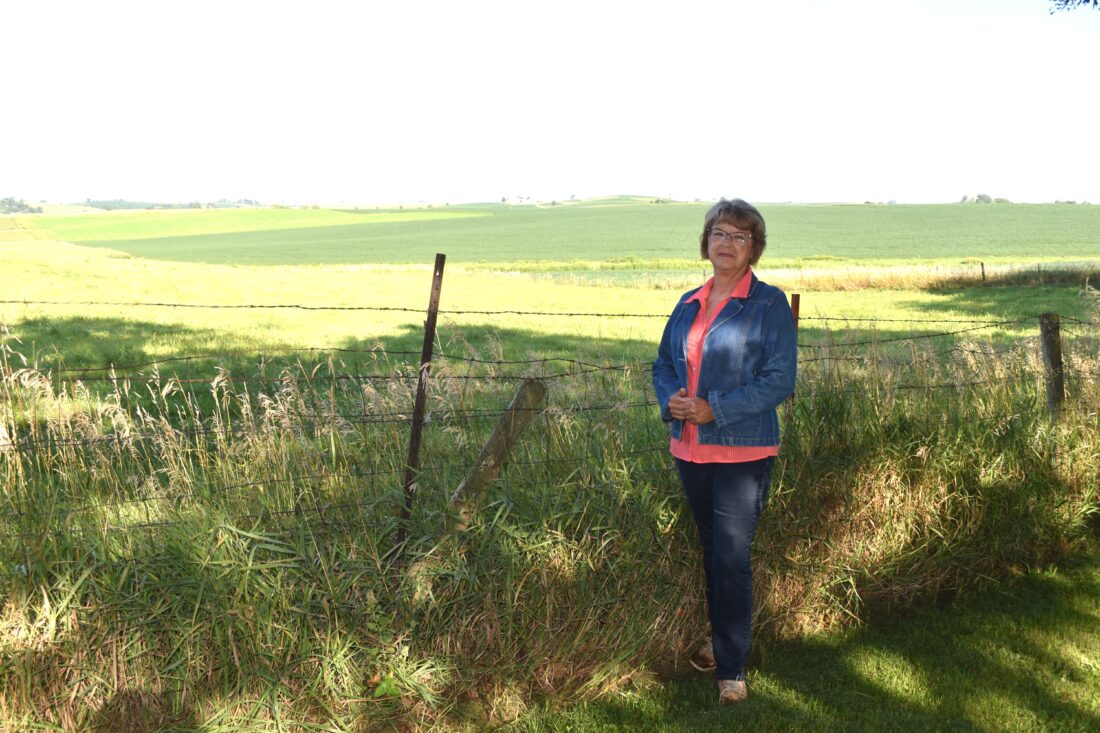
TAMA-GRUNDY PUBLISHING FILE PHOTO - Berleen Wobeter, pictured on her farm north of Toledo, spoke out against President Trump’s tariff policies during a virtual roundtable hosted by the Iowa Democratic Party last Wednesday and again at a press conference after a Supreme Court ruling last Friday.
Some Iowa farmers and cattle ranchers have been negatively impacted by tariffs and are speaking out. Last Wednesday, Berleen Wobeter of rural Toledo, Dave Muhlbauer of Crawford and Ryan Marquardt of Madison participated in a virtual roundtable hosted by the Iowa Democratic Party (IDP) to voice their concerns about tariffs, trade policies and the lack of desired action from the Congressional delegation.
Wobeter kicked the roundtable off by stating it is important for farmers to make their voices heard. She and her husband grow corn, soybeans and have a small cow-calf herd. According to Wobeter, they got through the 1980s farm crisis by “staying the course” and ignoring the “go big or go home” message.
“It’s one thing to experience loss through natural disaster — drought, derecho and crop disease. We’ve been through it all. That comes with the business of farming and we bear those losses with stoic strength,” she said. “But losses caused by thoughtless and ill-informed government decision policy making, mistakes that are avoidable require a different response today.”
The blame needs to be placed on those who have failed Iowa farmers, Wobeter said. Her operation was hurt with tariffs placed by the first Donald Trump presidential administration. Trade was lost and never fully recovered.
“Here we are again, and where is our Iowa delegation?” she asked. “If they showed up, we could tell them how this turns out for us back home in Iowa, but they’re in D.C., and time and time again, using their voices and votes to feather their comfortable D.C. nest, ignoring us, literally ignoring us and refusing to show up here face to face and hear us.”
During President Joe Biden’s administration, Wobeter said Rep. Ashley Hinson (R-Iowa) held a town hall that she attended. She asked Hinson about country of origin labeling (COOL) for beef. The matter was not covered in Hinson’s talking points, and Wobeter was told a staff member would get back to her, but that never happened.
“This is a real issue for beef producers like us, and consumers,” she said. “But apparently not important enough to Rep. Hinson.”
Implementing COOL is an action Wobeter said she would like to see, and it would be a simple one. Muhlbauer said he does not know of a single cattleman who is not in favor of COOL. If the government can give Argentina $40 billion for beef not raised to the standards of the American cattle industry, there is an impact on the ability of the consumer to choose what they want to buy.
“That’s where country of origin is huge,” he said.
Wobeter added that the Argentina deal could bring in diseases, such as foot-and-mouth. American people do not know what is in the Argentinian beef they buy.
The response to the “growing disaster” from the Iowa delegation is not acceptable for farmers and ranchers, Wobeter said. They are contributing to the problem by supporting chaotic tariffs and trade policies and unwillingness to pass meaningful legislation and an overdue Farm Bill, she argued.
Iowa farmers are not feeling the love, Wobeter said, when beef is imported from Argentina.
“Somehow paying [Iowa] farmers a fair price for their work to raise high quality beef in a challenging environment is asking too much,” she said. ” . . . Someone needs to start paying attention in D.C.”
Speaking after Wobeter, Muhlbauer said they keep getting told tariffs will make things better, but it does not happen. All of their concerns are falling on deaf ears, he added, but is grateful for the opportunity to participate in the roundtable with the hope Congressional representatives will hear them.
“All the while, we see farmers suffering,” Mulbauer said. “. . . We do all we can, but we’re not being helped out. And we don’t need to be helped out. We just need free and fair trade markets and a plan, and there is no plan. That is where it gets to be really frustrating. We see our legislators not work with Canada, who is one of our biggest trade allies in agriculture.”
Marquardt said he would like to see oversight with implementing tariffs.
“I think it comes down to, as farmers we just start being pawns here,” he said. “We’re tired of being sacrificed everyday.”
Marquardt has not seen anything hopeful from the Trump administration when it comes to tariffs and trade.
“The biggest problem is that trade relationships take years to cultivate, and ours are destroyed,” he said. “We’ve done a tremendous amount of damage in the last few months, basically one year. It’s going to take decades to repair or cultivate new avenues for those commodities.”
Farmers speaking at IDP press conference view SCOTUS ruling as ‘welcome’
Two days after expressing frustrations over tariffs during a virtual roundtable event, the same group of farmers expressed a sense of hope when some of those tariffs were struck down last Friday.
United States Supreme Court justices, in a 6-3 ruling, determined that the International Emergency Economic Powers Act and reciprocal tariffs placed by President Donald Trump were unconstitutional.
After the ruling, Wobeter spoke during an Iowa Democratic Party (IDP) press conference with farmer Ryan Marquardt of Madison County. Wobeter and her husband grow corn, soybeans and have a small cow-calf herd.
With tariffs playing an integral part in Trump’s administration, people are expecting the President to respond — which he did by declaring he would sign an executive order for a 10 percent global tariff. When asked for thoughts about the global tariffs, Wobeter said she felt people want a rational response to an irrational reaction.
“He simply doesn’t base his arguments on rational thought,” she said. “Tariffs are a tool, so they can be used sometimes. The trade deficit is not necessarily a huge problem, and he just has his own take on all this. I can’t give you a rational answer to what’s going to come next or whether it’s the right thing to do.”
Marquardt compared the global tariffs to driving in a finishing nail with a sledge hammer, and is expecting another mess. Providing examples, he said Trump could use the 1962 Trade Expansion Act or the 1974 Trade Act to get around the court’s ruling.
“That’s kind of what I expect,” he said. “[Tariffs] are kind of his thing. It’s like the only thing he’s tried to run on, but it hasn’t done much for us at all. It’s only been damage and pain.”
One of Wobeter’s biggest concerns is the loss of perspective of the future of land, farmers and communities.
“This isn’t just about profit,” she said. “This is about how do our communities exist? Will we have safe food? Are we protecting our soil? We can’t even get down to those kind of discussions in this present environment.
Marquardt described the Supreme Court ruling as welcome.
“The tariffs have really resulted in an increase in input costs and kind of eroded or erased our export markets,” he said. “They triggered retaliatory tariffs against us. This is very welcome news to be finally turning the page on this, although I have little faith the administration will not look to the other tools that it has to try to extend tariffs.”
Local News
Tama County farmer speaks out on Trump’s tariff policy, reacts to SCOTUS ruling

Memorandum to Public Health

‘PIEOWA’ screening a slice of success at Gladbrook Theater
The last year for fireworks?
July 4, 2026, will be the last year for fireworks set off by the City of Toledo. At Monday’s Toledo Council ...

‘Iowa’s Religious History’ set for March 11 at Wieting Theatre
