

In the Sky: Lunar Eclipse March 3
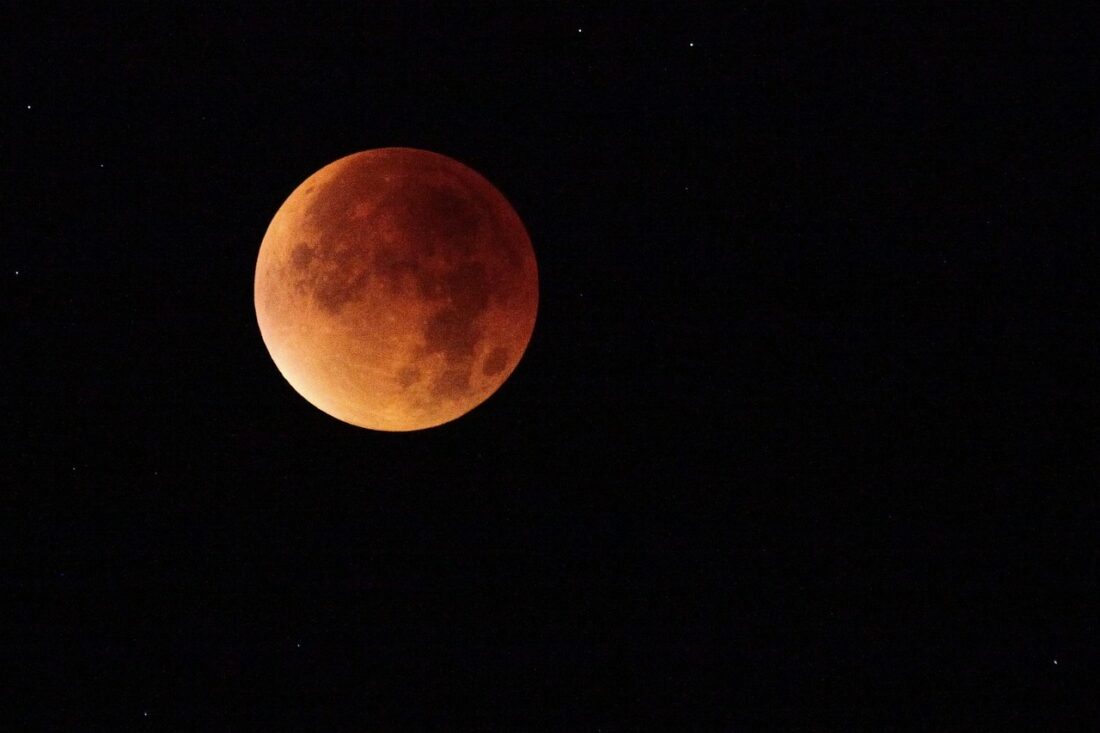
March will be a very special month with several interesting events happening in the sky. Foremost is a total eclipse of the Moon on March 3. However, nature will play a cruel trick by having the eclipse in the very early morning. You will need to stay up late or get up early to see it. Totality will begin at 5:04 a.m. CST and last until 6:03 a.m. CST. Everyone having night then will see the eclipse, but the hour will vary according to your time zone.
An eclipse of the Moon is one of the best sights in astronomy, and it is well worth taking some effort to see it. Lunar eclipses happen because the Moon’s orbit around the Earth takes it through Earth’s shadow that extends out from the night side of the Earth. An eclipse can only happen during a full Moon since the Moon is then also on the opposite side of the Earth from the Sun. However, it does not happen every month because the Moon’s orbit is tipped from the plane of the Earth’s orbit around the Sun. As a result, the Moon usually passes above or below the Earth’s shadow. This makes a lunar eclipse truly special.
The eclipse will begin almost imperceptibly when the Moon enters the faint outer shadow of the Earth, but the real action will start when the Moon enters Earth’s dark inner shadow, called the umbra, at 3:50 a.m. CST. This first “bite” out of the Moon is always on the left or east side because the Moon is moving eastward in its orbit. As the partial eclipse progresses, you should notice that the edge of Earth’s shadow is always curved. This was one of the proofs Aristotle used to show that the Earth was round. Only a round object will always cast a shadow that is curved.
During totality, the Moon will be fully within the Earth’s shadow, but it will not be totally dark. It will have a reddish color, often called a Blood Moon, that is caused by the Sun’s light being bent, or refracted, as it passes through Earth’s atmosphere and then falls on the Moon. If you were on the Moon, the Earth would be black with a reddish band around it – all the world’s sunrises and sunsets. Totality will end when the Moon starts to leave Earth’s shadow, and the partial eclipse will be over at 7:17 a.m. CST, after sunrise for many viewers.
Saturn will leave us during March, but before it goes it will have one last special event. It will pass very close to brilliant Venus low in the western sky on the evenings of March 7 and 8. After this close passing, Saturn will soon drop into the twilight glow while Venus slowly climbs higher. The final special event will be a close pairing of brilliant Venus and the crescent Moon early in the evening of March 20.
Observing Highlights
-Mar. 1: The bright Moon will rise before Regulus, the brightest star in Leo (the Lion). It will follow Regulus on March 2.
-Mar. 3: Eclipse of the Moon. Totality will be from 5:04 to 6:03 a.m. CST. See above.
-Mar. 5: The Moon will rise at about 10:00 close to the upper right of Spica, the brightest star in the constellation Virgo (the Maiden). The Moon will move eastward in its orbit and be below Spica on the 6th.
-Mar. 7-8: Brilliant Venus will pass very close to Saturn. Look low in the western sky about 30-40 minutes after sunset.
-Mar. 20: This is the day of the spring equinox when everyone will have 12 hours of daylight and the Sun will rise straight in the east and set straight in the west (except at the poles). Also, the crescent Moon will be above Venus low in the western sky during the early evening.
-Mar. 22: The Moon will be below the Pleiades (or Seven Sisters) open star cluster with Aldebaran, the bright reddish eye of Taurus (the Bull), farther to their upper left.
-Mar. 26: The Moon will be below or to the lower right of Pollux with Castor above Pollux, the bright twin stars in Gemini (the Twins). Very bright Jupiter will be to their right or lower right.
-Mar. 29: The bright Moon will be below Regulus, the brightest star in Leo (the Lion).
Local News

Tama County farmer speaks out on Trump’s tariff policy, reacts to SCOTUS ruling

Memorandum to Public Health

‘PIEOWA’ screening a slice of success at Gladbrook Theater
The last year for fireworks?
July 4, 2026, will be the last year for fireworks set off by the City of Toledo. At Monday’s Toledo Council ...

‘Iowa’s Religious History’ set for March 11 at Wieting Theatre
