

Going on a road diet
Work to convert Highway 63 from four to three lanes through Tama-Toledo underway
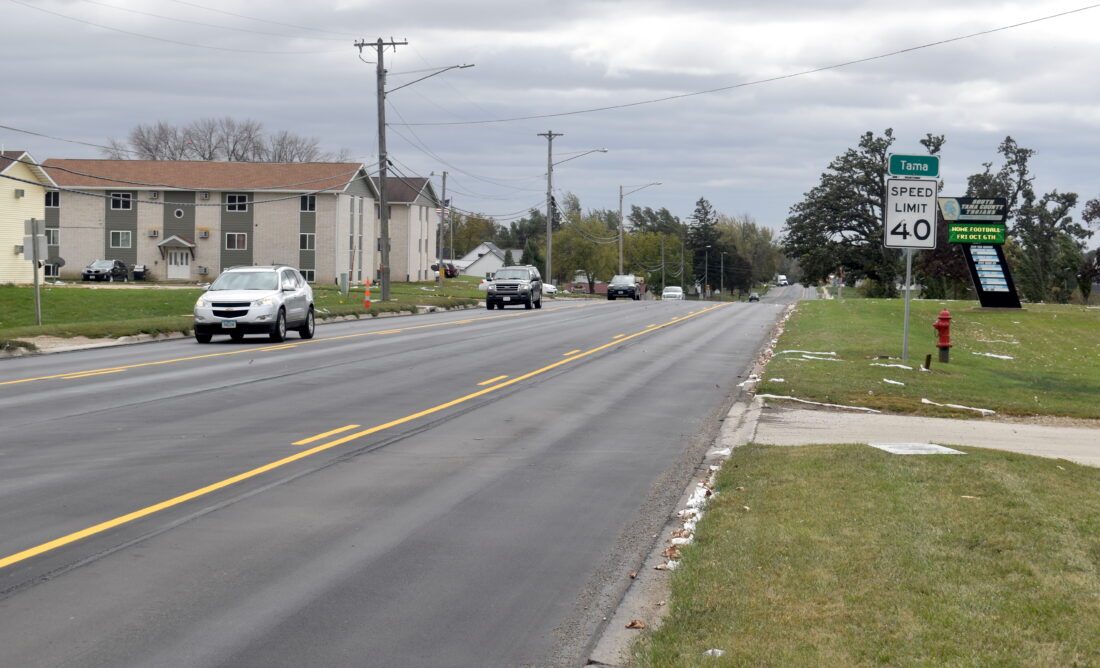
NEWS CHRONICLE PHOTO BY ROBERT MAHARRY — The Iowa DOT is currently in the process of reducing Highway 63 from four to three lanes all through Tama and Toledo. A high number of crashes in the area around the STC elementary and high school campus near the border between the two communities, pictured, was cited as one of the instigating factors for the change.
Drivers along the main road that runs north and south through Tama and Toledo may have recently noticed a somewhat major change. Highway 63 is going on a diet.
Citing concerns with crashes, especially near the South Tama County elementary/high school campus near the border between the two communities, officials at the Iowa Department of Transportation (DOT) began to study the possibility of reducing the roadway from four to three lanes with a left-turn lane in the center — the only exception is the area right around the Highway 30 interchange, which will stay the same.
Benjamin Adey, a staff engineer with the DOT based out of the Grimes office, said he first heard from an STC school board member several years ago who expressed safety concerns about the area around campus, prompting a larger review of the state highway as it runs through the conjoined cities.
“When we looked at that, we generally took a look at the overall corridor, essentially from the south city limits of Tama to the north city limits of Toledo, and there were 95 crashes from 2016 to 2020,” Adey said. “It seems a little high. But more specifically what we looked at was what types of crashes they were, and they were specifically left turn, crossing and rear-end crashes.”
Of those 95 crashes during the period, 20 were in front of the school, and 11 were left turn, crossing and rear-end. The most trusted fix to those types of collisions, according to Adey, is the four to three lane conversion.
“Typically, when we do the four to three lane conversion, we see about a 50 percent reduction in those types of crashes,” he said. “They eliminate conflict points. So when you have two lanes in each direction, if you think about it, if you’re making a left hand turn, you have to cross two lanes of traffic, so there’s two points that you would potentially conflict with. If somebody’s making a left turn, you could rear end them if you’re not paying attention, or if they’re making a right turn you could rear end them. Or even if you’re just changing lanes, you have the potential for side swipes.”
Work began within the last few weeks, and most who use the road have probably already noticed the change in Tama. The lanes are still being repaved headed north through Toledo, hence the “uneven lanes” sign around the typically busy Business 30 intersection. Adey said the plan is to resurface the road to eliminate the old pavement markings and avoid “scarring” so drivers will know where they need to be when the stripes have been repainted.
Other cities in Iowa like Glenwood and Osceola with similar traffic numbers where lane reductions have been implemented — Adey estimated that Highway 63 in Toledo sees about 6,600 vehicles a day, and Tama about 5,300 — have seen crash reductions of 50 to 55 percent. “This is a proven safety countermeasure, you know, especially for corridors where we look at the types of crashes that have happened,” Adey said. “These are the ones that we’re gonna solve with this. Those are the types of crashes that we’re seeing in this corridor.”
In addition to the crash concerns, Karen Mixdorf, a retired STC teacher who now serves on the Tama-Toledo Community Visioning Committee, mentioned a desire to make the towns more pedestrian friendly in the future — noting the school area and the fact that Toledo Heights Park is across the highway from where most of the city’s population lives.
“It’s my understanding that what it does is provide some relief for the pedestrian as they’re crossing, so instead of having to watch two lanes both ways as they’re crossing, you’re gonna watch one lane going south. You have a little bit of respite in the middle unless there’s a car turning, and then you’ve gotta watch the other lane going north,” she said. “So that right there does (provide) relief, but also, the DOT, in their initial meeting, said we didn’t have the traffic to warrant four lanes of traffic.”
She added that while car travel has always been the primary focus in the U.S., particularly in smaller, more rural communities, Mixdorf hopes moves like this one will help to strike a better balance between drivers and walkers.
“Yes, you need to get people in their cars to where they need to go as quickly as possible, but you also need to make safe routes for people to travel,” she said. “That’s a major corridor. Our two major grocery stores (we have another in down in Tama) are there. There’s a bank there, the Dollar General is there, and a lot of people that can’t drive walk to that location. And right now, we don’t have a really good safe way for people to get there, so the conversion will help.”
Community Visioning is also working with Region 6 Resource Partners to secure a grant for a crossing light and crosswalk at 16th Street and Highway 63, and a crosswalk was recently added at Business 30 and Broadway in Toledo.
“It’s a big puzzle is kind of how we look at it, and has lots of pieces that we’re trying to put together as money and funds become available and the city has time to work on it, things like that,” Mixdorf said.
Local News
Chelsea park project comes to fruition with strong community support
Breaking ground on future memories
Tama council finalizes joint police department agreement
This week’s Tama City Council meeting started with an update on a nuisance property, and they decided to extend ...

Elberon man gets six-year federal sentence for illegal gun possession

MSS 2026 Homecoming Court announced
