

Tama County Historical Society fulfills local needs
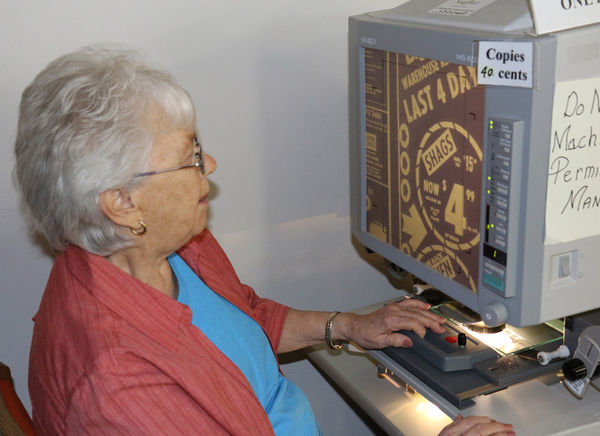
Wilma Parizek scrolls through a newspaper that has been put on microfilm. The microfilm is kept at the Tama County Museum and Historical Society in Toledo. News Herald Photo/Allison Graham
Social media content, the popular venue for what’s going on now, likely won’t exist for future historians. Perhaps there’s efforts to maintain and preserve what is reported, but find it. The challenge and the duty of your weekly newspapers has long been to make certain a record of what went on in Toledo, Tama, Chelsea, Montour, Vining and all of Tama County continues to exist for future generations. Whether it was uncle Harry building a new store or aunt Nellie campaigning for a courthouse candidate, the newspaper records have stood in Iowa over the years. An IowaWatch story today calls attention to the drop of state-wide funding to continue to preserve Iowa’s newspapers for the future. Here in Tama County, we do continue to enjoy the preservation efforts through the Tama County Historical and Genealogical Society. Society President Joyce Wiese reports all Tama County newspapers are microfilmed and brought up-to-date every three years. that includes The Toledo Chronicle, Tama News-Herald, Traer Star-Clipper, Dysart Reporter and Gladbrook Northern-Sun Print. Plans also call for microfilming and updating the Reinbeck Courier and Belle Plaine Star Press Union as part of the collection.
IOWA WATCH STORY:
Newspapers piling up since 2009 while State Historical Society decides how to preserve them
By Lauren Mills, IowaWatch.org
Bundled stacks of newspapers fill shelves and overflow onto the floor in the archives of the State Historical Society of Iowa in Des Moines. Traditionally, the papers would have been sent off to for preservation, but a 2009 budget cut ended that 50-year practice. Some historians and activists are anxious to have the papers preserved to ensure the so-called first draft of Iowa history is available to future generations. A bill proposed last year would have provided funds for the backlog, but the Iowa Department of Cultural Affairs, which oversees the historical society, put on the brakes. It rejected the proposed funding citing pending completion of a master planning process and assessment study to evaluate what it has in the archives and how to preserve those materials in the future. The moves come as newspapers increasingly are adopting digital means of producing and publishing their work, and while historians and preservationists debate whether future preservation should move abandon microfilm for that digital world. Microfilm long has been considered a preservation gold standard but it lacks the accessibility of digital archives. The backlog, which includes 1,600 to 1,700 bundles of newspapers, would cost roughly $255,000 to preserve on microfilm. And papers continue to pile up. Officials with the historical society said the collection assessment will provide the cultural affairs department with a complete picture of what exactly is in the state archive. It also will help officials plan for future preservation efforts for newspapers and other items in the collection such as photographs and manuscripts. “It’s not an exaggeration to say that we have never done an assessment this detailed and this extensive across a hundred plus years of holdings,” Anthony Jahn, the state historical society’s archivist, said. Iowa Watch credit: This story was produced by Iowa Center for Public Affairs Journalism-IowaWatch.org, a non-profit, online news Website that collaborates with Iowa news organizations to produce explanatory and investigative reporting.
This story was produced by Iowa Center for Public Affairs Journalism-IowaWatch.org, a non-profit, online news Website that collaborates with Iowa news organizations to produce explanatory and investigative reporting.
Local News

Discussions and approvals: Tama County Supervisors meeting

Pete Lyon to be inducted into 2026 Iowa 4-H Hall of Fame

Ahrens discusses potential conference change with school board
Tama County U.S. 63 closure schedule update
The tentative start date to begin breaking up the existing pavement is Aug. 10. Once that begins, the pavement will ...
Louise & Lucile Hink Tama Public Library receives accreditation from the State Library of Iowa
DES MOINES — The State Library of Iowa announced that the Tama Public Library has met the conditions for state ...
South Tama Community School District recipient of DOE award
DES MOINES — The Iowa Department of Education recently announced more than $2.35 million in competitive grants ...